How to Calculate Square Feet for Flooring (Without Over-Ordering)
To calculate square feet for flooring, multiply room length by width, then add a waste factor. A 12×10 room is 120 square feet net. With 10% waste, you order 132 square feet. But that flat 10% doesn't work for every project. Tile needs more. Carpet works differently. And layout direction can shift the total by 15% or more.
Buy too little and the job stops halfway through. Buy too much and you've got boxes sitting in the garage for years. Getting this number right comes down to knowing your material, your layout, and the extras most people forget.
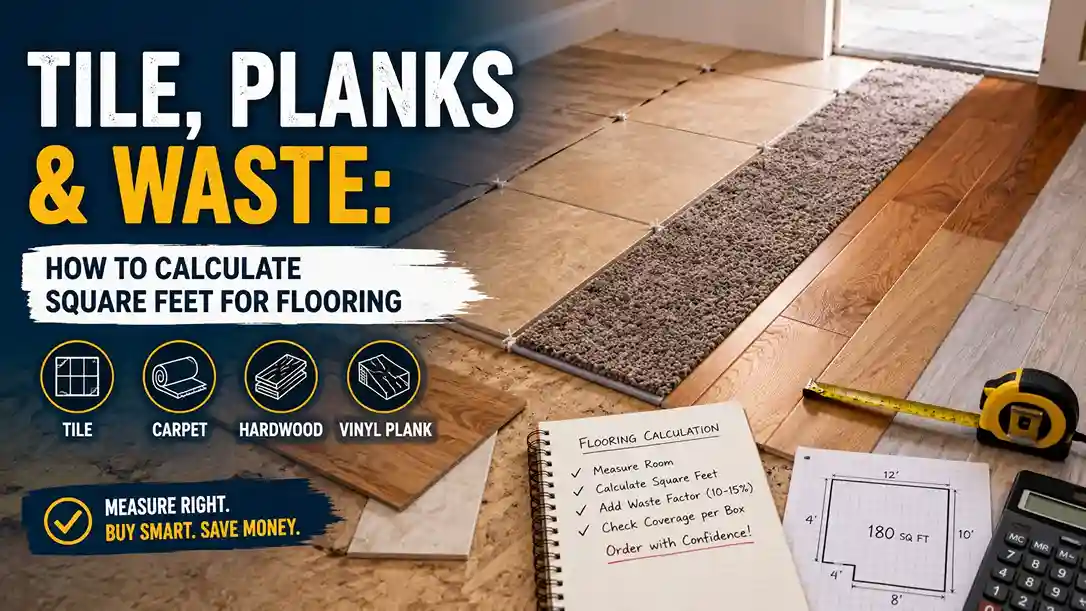
Why Room Square Footage Alone Doesn't Work
A room's square footage is your starting point, not your final order. Flooring gets cut. Corners, doorways, closets, and odd angles all eat into material. That's what the waste factor covers: cutting, mistakes, and pattern matching.
If you're not sure how to measure your room correctly first, our guide on measuring a room walks through the process before you start ordering.
Waste Factor by Flooring Type
A flat 10% doesn't work for every project. The right waste factor depends on your material and layout pattern.
| Flooring Type | Straight Layout | Diagonal / Pattern |
|---|---|---|
| Vinyl / LVP | 7-10% | 12-15% |
| Laminate | 8-10% | 15% |
| Hardwood | 10-12% | 15-18% |
| Tile | 10-15% | 15-20% |
| Carpet | 10-15% + seam extra | N/A |
Larger tiles waste more because fewer cuts fit neatly around edges. Smaller mosaics waste less. Patterned layouts always use more than straight lay.
How to Calculate Square Feet for Tile
Tile comes in fixed sizes, so there's one extra step. First, find your room's square footage with the waste factor included. Then divide by the area of one tile.
A 12×12 inch tile covers exactly 1 square foot. A 150 square foot room with 10% waste needs 165 square feet covered, which means 165 tiles at that size. But tiles are sold by the box, and box coverage varies. Some boxes hold 10 square feet. Others hold 20. Always check the label.
Larger format tiles like 18×18 or 24×24 usually need slightly more waste since fewer cuts fit cleanly around a room's edges. Smaller mosaic tiles often need less.
How to Calculate Square Feet for Carpet
Carpet works differently. It comes on rolls, usually 12 feet wide, and it's priced by the square yard. A room wider than 12 feet needs a seam somewhere, and seams are placed to be as invisible as possible. That sometimes means buying more carpet than the raw square footage suggests just to keep the seam in a good spot.
To convert: divide your total square footage by 9. A 300 square foot room comes to about 33.3 square yards. Add a buffer for seam placement, and you're likely ordering closer to 35 square yards.
If you're converting between square feet and square yards, our unit conversion guide covers that.
Hardwood, Laminate & Vinyl Plank
These materials come in individual boards, sold by the box with coverage printed on the label. Board length matters in a way tile doesn't. Rooms longer than a single board need end-to-end seams, and a smart layout staggers those seams so they don't line up in a noticeable pattern.
That staggering uses slightly more material. It's part of why the standard 10% waste factor exists. For diagonal layouts, bump that to 15%.
Layout Direction Changes Everything
How you run the planks changes how much you waste. Straight lay parallel to the longest wall wastes the least. Diagonal at 45 degrees wastes 15-20%. Herringbone or chevron patterns can waste up to 30%.
For rooms with odd shapes or multiple entry points, plan the direction before ordering. On larger rooms, the layout can shift total square footage needed by a noticeable amount. Our square footage formula guide covers the basics if you need a refresher.
A Real Example: 180 Sq Ft Bedroom
Let's run the numbers on a standard bedroom.
Tile: 180 sq ft + 10% waste = 198 sq ft. At 15 sq ft per box = 13.2 boxes. Round up to 14.
Carpet: 180 sq ft ÷ 9 = 20 sq yards. Add seam buffer. Order 22 sq yards.
Hardwood: 180 sq ft + 10% = 198 sq ft. At 20 sq ft per box = 9.9 boxes. Round up to 10.
Rounding matters. Stores sell full boxes, not partial. Always round up, never down. For more on how material costs stack up with waste included, our square footage price guide covers that.
Measuring Around Closets, Doorways & Fixtures
The spaces you forget to measure are the ones that make you run short. A closet that shares the same continuous floor as the main room needs covering. Doorways often get a few inches of flooring to meet the next room's threshold. Kitchen islands sometimes get floored underneath, sometimes not, depending on whether they're built-in or freestanding.
Measure everything you're going to touch with materials. Decide what counts before you start.
Frequently Asked Questions
How much extra flooring should I buy beyond the room's square footage?
About 10% for most rooms with a straight layout. Diagonal layouts or rooms with lots of corners usually need closer to 15%. Carpet needs extra for seam placement.
How do I calculate square feet for tile specifically?
Measure the room, add your waste factor, then divide by the area of one tile. Check the box for exact coverage per box. A 12×12 tile covers 1 square foot.
Is carpet sold by the square foot or square yard?
Usually by the square yard. Divide your total square footage by 9 to convert. A 300 sq ft room is about 33.3 sq yards.
Do I need to floor inside closets?
Usually yes, if the closet shares the same continuous floor as the main room. Measure it separately and add it to your total.
Does tile size affect how much waste factor I need?
Yes. Larger tiles often need slightly more waste due to fewer clean cuts along edges. Smaller tiles typically need less.
What happens if I don't buy enough flooring?
You'll likely need a second order. Sometimes at a different dye lot or batch, which can create a visible mismatch. Better to have a spare box than to run short.
Final Thoughts
The room's square footage is only the starting point. Waste factor, box coverage, roll width, and layout pattern all shift the real number you need. Skipping any one of these is usually why flooring projects run short or end up with a pile of leftovers.
Once you know your room's exact square footage, our area calculator includes a Flooring purpose setting that adds the waste factor and tells you how many boxes to buy automatically.
Updated: September 2026