How to Calculate Square Feet from Feet, Inches, Meters & Yards
To calculate square feet from feet, multiply length by width. That's the easy part. The tricky part? Real-world measurements rarely come in one clean unit. A wall is 12 feet 6 inches. A blueprint lists 3.8 meters. A carpet quote asks for square yards.
Mixing units before doing the math is where most conversion mistakes happen, not in the formula itself. This guide covers every common conversion you'll run into: inches to feet, feet-and-inches to decimal feet, square feet to square meters, square yards, and cubic yards.
If you're already comfortable with the basic length × width formula, our square footage formula guide covers the fundamentals before you start converting units.
The One Rule That Matters Most
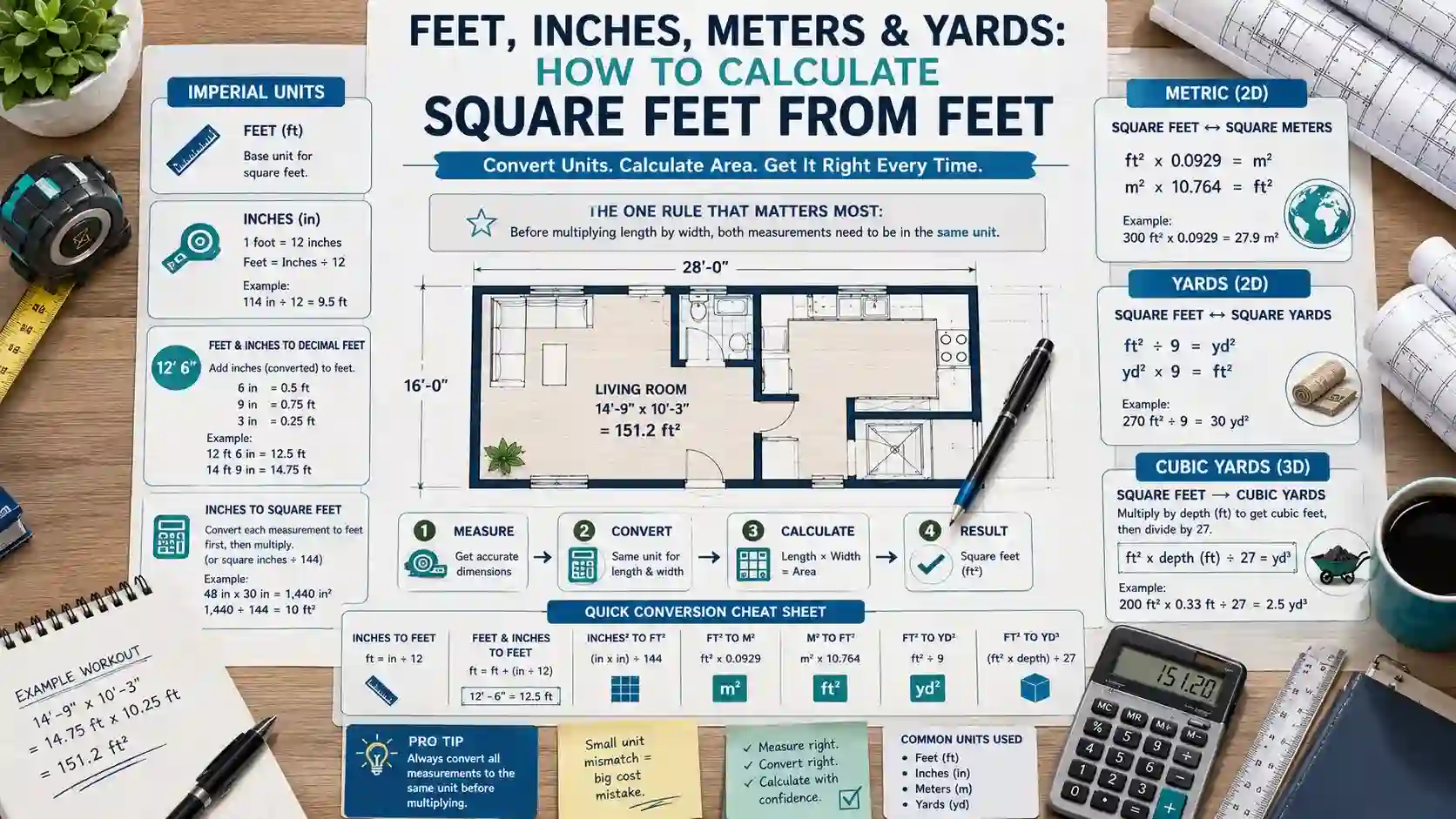
Before multiplying length by width, both measurements need to be in the same unit. That's it. That's the rule everything else in this guide builds on.
Mixing units mid-calculation, even by accident, throws off the area in a way that isn't always obvious. A 96-inch by 60-inch space isn't 5,760 square feet. That number is in square inches. Convert each measurement to feet first (8 feet by 5 feet), and you get the correct 40 square feet.
For a step-by-step walkthrough of measuring a room from start to finish, our practical measuring guide covers the hands-on process in detail.
Converting Inches to Feet
Since a foot equals 12 inches, converting is a single division. Take the inch measurement and divide by 12 to get decimal feet.
A wall that measures 114 inches long comes out to 9.5 feet (114 ÷ 12). Once every measurement is in feet, the regular area formula applies as normal.
This matters most when you calculate square feet by inches directly. A 48-inch by 30-inch countertop section works out to 1,440 square inches. Divide by 144 (since one square foot equals 144 square inches), and you get exactly 10 square feet.
Handling Feet-and-Inches Measurements Together
Real-world measurements often come as a mix, like 12 feet 6 inches rather than a clean number in one unit. Convert the inches portion to a decimal first, then add it to the feet.
Six inches is half a foot, so 12 feet 6 inches becomes 12.5 feet. Nine inches converts to 0.75 feet. Three inches converts to 0.25 feet.
A room measuring 14 feet 9 inches by 10 feet 3 inches converts to 14.75 feet by 10.25 feet, which multiplies out to about 151.2 square feet. Skip the conversion and multiply 14.9 by 10.3 instead, a common shortcut, and the area comes out to 153.5 square feet. A small error, but it grows on larger rooms.
Converting to Square Meters
Converting between feet and meters comes up often with imported materials or international blueprints. The formula is simple: square feet × 0.0929 equals square meters.
A 300 square foot room converts to roughly 27.9 square meters. Going the other direction, multiply square meters by 10.764 to get back to square feet.
Rounding this conversion factor too aggressively (using 0.09 instead of 0.0929) introduces a small error that becomes more noticeable on larger areas. Stick with the full decimal for accuracy.
Converting to Square Yards
This conversion stays two-dimensional, which makes it simpler than the cubic yard version below. One square yard equals 9 square feet, so dividing your square footage by 9 gives you square yards directly.
Carpet is often priced by the square yard. Take the room's square footage and divide by 9. A 270 square foot room converts to exactly 30 square yards.
Converting to Cubic Yards (The One That Trips Everyone Up)
This conversion crosses from a flat, two-dimensional measurement into a three-dimensional one. Square footage alone can't convert to cubic yards without one more number: depth.
To calculate square feet to cubic yards, multiply the square footage by the depth in feet to get cubic feet, then divide by 27 (since one cubic yard equals 27 cubic feet).
A 200 square foot garden bed filled 4 inches deep (0.33 feet) comes to about 66.6 cubic feet, which divides down to roughly 2.5 cubic yards of soil or mulch.
Skipping the depth measurement entirely is the single biggest mistake in this type of conversion. Square feet describes a flat surface. It has no built-in depth, so there's no way to calculate cubic yards without measuring or deciding on that third dimension first.
Quick Reference Table
| Convert From | Convert To | Formula | Example |
|---|---|---|---|
| Inches | Feet | Divide by 12 | 114 in → 9.5 ft |
| Feet + inches | Decimal feet | Inches ÷ 12, add to feet | 12'6" → 12.5 ft |
| Square inches | Square feet | Divide by 144 | 1,440 sq in → 10 sq ft |
| Square feet | Square meters | Multiply by 0.0929 | 300 sq ft → 27.9 sq m |
| Square feet | Square yards | Divide by 9 | 270 sq ft → 30 sq yd |
| Square feet + depth | Cubic yards | (Sq ft × depth in ft) ÷ 27 | 200 sq ft × 0.33 ft → 2.5 cu yd |
Common Mistakes in Unit Conversion
- Multiplying before converting. Multiplying two inch measurements together and dividing by 12 instead of 144 gives a wrong answer. Area conversion factors square, not just double.
- Rounding conversion factors too early. Using 0.09 instead of 0.0929 for square meters compounds into a real error on larger spaces.
- Treating cubic yards like a square footage conversion. Square feet has no depth built in. Skipping the depth measurement entirely is the most common reason a cubic yard estimate comes out wrong.
- Dropping inches in as decimals without converting. Writing 12 feet 6 inches as 12.6 instead of 12.5 is an easy typo that quietly shifts every calculation that follows.
- Mixing metric and imperial mid-project. Ordering material in square meters after measuring in feet, without converting first, leads to ordering the wrong amount entirely.
Why Getting Conversions Right Matters
A landscaping order is one of the more common places this goes wrong in practice. Ordering mulch by cubic yards without properly converting from square footage and depth either leaves a project short on material or wastes money on a surplus.
Flooring priced by the square yard runs into a similar risk. Ordering based on square footage instead of the correct square yard conversion can throw a material order off by roughly 10%, which adds up fast on a whole-house project.
For official guidance on measurement standards and unit conversion, the National Institute of Standards and Technology (NIST) reference provides authoritative information on measurement practices.
Frequently Asked Questions
How do I calculate square feet from feet measurements?
If both length and width are already in feet, multiply them directly. No conversion is needed. This is the simplest case.
How do I calculate square feet by inches?
Divide each inch measurement by 12 to get feet, then multiply length by width normally. Or multiply the inches together and divide by 144 to get square feet directly.
What's the easiest way to convert feet and inches to decimal feet?
Take the inches, divide them by 12, then add that decimal to the whole feet number. Six inches is 0.5, nine is 0.75, and so on.
How do I convert square feet to square meters?
Multiply your square footage by 0.0929 to get square meters. To go the other way, multiply the square meters by 10.764.
How do I calculate square feet to cubic yards?
Multiply the square footage by the depth (in feet) to find cubic feet, then divide that by 27. You always need a depth measurement since square footage alone can't give you a volume.
Can I mix metric and imperial measurements in one calculation?
No. You have to convert everything to the same unit system first. If you don't, the final area figure won't make sense.
Final Thoughts
Every conversion in this guide comes down to the same idea: get every measurement into the same unit before doing any multiplication. The formulas are simple divisions and multiplications. The real skill is remembering which conversion applies to which situation, especially the jump from flat square footage into a volume-based unit like cubic yards.
For measurements that mix feet, inches, meters, and yards in the same input, our area calculator detects the unit automatically and handles the conversion for you.
Updated: September 2026