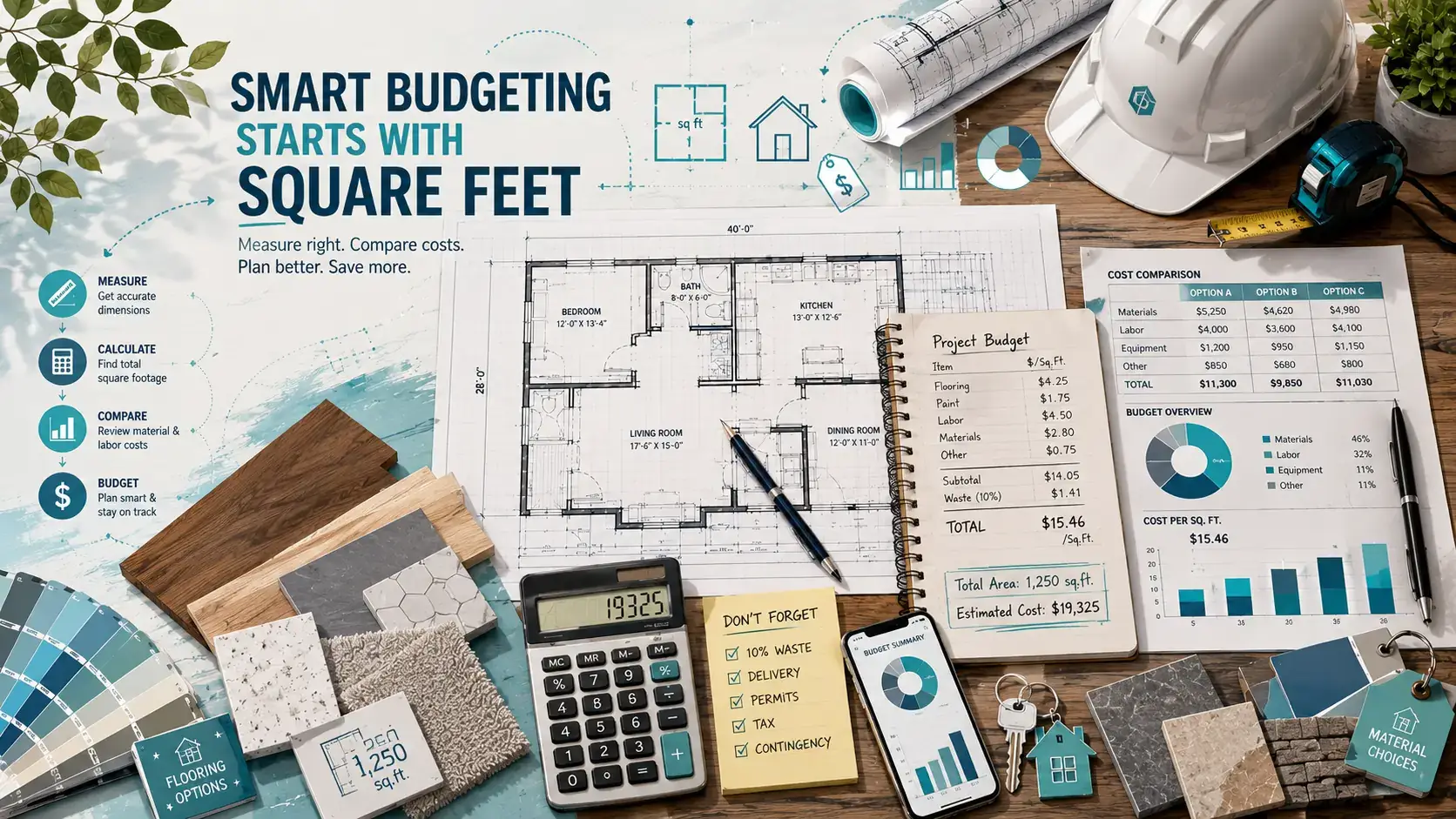
Budgeting for a Project: Calculate Square Footage Price the Right Way

Calculating square footage price for flooring, painting, and remodeling projects

A contractor quotes $8,000 for a 400 square foot bathroom remodel. Another quotes $14,000 for the same space. Same square footage, wildly different numbers — and the gap usually isn't about who's overcharging. It's about what's actually included in that price per square foot.

Learning to calculate square footage price gives you a way to sanity-check quotes, compare materials, and catch the difference between a fair estimate and one that's missing something big. The math itself is simple. Knowing what goes into the number is where the real skill is.

If you're not sure how to get your measurements right in the first place, our guide on measuring a room walks you through the process. And for a deeper look at the formula itself, our square footage formula guide covers the basics before you start comparing prices.

The Basic Price Formula

Total Cost = Square Footage × Price Per Square Foot

A 200 square foot room at $4 per square foot comes out to $800. That's the whole calculation. The hard part isn't the multiplication — it's figuring out what the price-per-square-foot number should actually be, since that figure changes based on material, labor, region, and a handful of other things most people don't think to ask about.

Where "Price Per Square Foot" Numbers Actually Come From

Suppliers and contractors don't pull price-per-square-foot numbers out of thin air. For materials, it usually comes straight from how the product is packaged and sold — tile boxes list coverage per box, paint cans list coverage per gallon, and the price per square foot gets derived from there.

For labor, it's different. Contractors price by square foot as a shorthand for a much more complicated estimate that factors in how long a job takes, how many workers it needs, and how difficult the specific space is to work in. A 200 square foot room with simple, open walls costs less per square foot to paint than a 200 square foot room full of trim, corners, and cutting-in around windows — even though the area is identical.

This is exactly why you calculate square feet cost first, then treat the price-per-square-foot number as a starting point rather than a fixed rule. The same material, same square footage, can land at very different totals depending on what else the job involves.

Typical Price Ranges by Material

These are general ranges, not quotes — actual pricing depends heavily on your region, the specific product, and current material costs, so treat this as a starting point for comparison rather than an exact number.

Laminate flooring often runs $1 to $5 per square foot for material alone. Hardwood flooring tends to run higher, often $6 to $12 per square foot before installation. Ceramic and porcelain tile can range anywhere from $2 to $15 per square foot depending on quality and style. Interior paint, once you factor in coverage per gallon, typically works out to roughly $1 to $3 per square foot of wall for material. Mulch and landscaping materials are usually priced per bag or per cubic yard rather than per square foot directly, which means converting your area into the right volume unit first.

Need to convert between square feet, square yards, or square meters for your material order? Our area calculator handles unit conversions automatically and includes a price field so you can see the total cost update instantly.

Don't Forget Labor

Material price per square foot and installed price per square foot are two completely different numbers, and mixing them up is where a lot of budget surprises come from. A quote that only covers material might look great next to one that includes labor — until you realize you'll need to pay someone separately to actually install it, or do it yourself.

Labor costs scale with square footage too, but not always in a straight line. Small jobs often carry a minimum charge regardless of size, since a contractor's time to show up, set up, and clean up doesn't shrink much just because the room is small. A 50 square foot bathroom and a 150 square foot bedroom might end up with a closer labor cost than the square footage difference would suggest.

Why Two Quotes for the Same Space Can Differ So Much

Beyond material and labor, a few things quietly change what "price per square foot" actually covers. Some quotes include removal of the old material — old flooring, old paint prep, demolition — and some don't. Some include permits, if the job needs one. Some build in a markup for unexpected complications, and some don't, which means the lower quote isn't always the better deal if it runs into surprises mid-project.

The fix isn't finding the cheapest number. It's asking each contractor exactly what their price per square foot includes, so you're comparing the same thing twice instead of comparing a stripped-down number to a comprehensive one.

Buying in Bulk vs. Buying Small

Price per square foot often drops as the total area goes up, which is worth knowing before you order material room by room. A supplier selling flooring by the box might charge more per square foot for a five-box order than for a fifty-box order, simply because bulk orders cost less to process and ship per unit.

This matters most for whole-house projects. Pricing out one room at a time and adding the totals can come out higher than getting a single quote for the entire project, since you lose whatever bulk discount would've applied to the combined square footage.

A Real Example

Say you're flooring a 300 square foot living room with laminate priced at $3.50 per square foot for material, plus installation quoted separately at $2.25 per square foot. Material comes to $1,050. Installation comes to $675. Combined, that's $1,725 before tax or any waste-factor buffer.

Add a standard 10% waste factor for cutting and fitting, and the material portion needs to cover roughly 330 square feet instead of exactly 300 — pushing material cost to about $1,155, and total project cost to around $1,830. That waste factor is easy to forget when budgeting off the raw square footage alone, and skipping it is one of the more common reasons projects run short on funds partway through.

If you're measuring a round space like a patio or pool, the circle area guide covers the radius-based math so you can budget accurately for circular projects too.

DIY vs. Hiring It Out

Skipping the installation portion of the price per square foot changes the budget significantly, but it shifts cost into time and tools instead of removing it entirely. A DIYer doing that same 300 square foot laminate job saves the $675 in labor, but usually needs to rent or buy tools — a flooring nailer, spacers, a saw for cutting boards — that a contractor already owns and factors into their rate.

There's also a learning curve cost that's harder to put a number on. A first-time installer typically uses more material than a professional would, since mistakes and re-cuts eat into the waste-factor buffer faster. Bumping the waste factor from 10% to 15% for a DIY job is a reasonable adjustment to make when budgeting, just to cover the extra material that inexperience tends to use up.

For smaller or simpler projects — a single accent wall, a small closet floor — the DIY savings are usually worth it. For larger or more technical jobs, like a whole-house flooring project or anything involving plumbing or electrical work tied to the square footage, the labor cost often reflects genuine expertise that's harder to substitute with a weekend of YouTube tutorials.

The same logic applies to creative projects too — naming a band, a team, or a project is about finding something memorable and easy to say. If you're looking for naming inspiration, our band name generator and team name generator cover similar creative territory.

Common Mistakes When Budgeting by Square Footage

  • Comparing material-only quotes to installed quotes. These aren't the same number, and treating them as comparable leads to budgeting for the wrong total.
  • Forgetting the waste factor. Ordering exactly the calculated square footage, with nothing extra for cuts and mistakes, usually means a second trip to the supplier mid-project.
  • Assuming price per square foot stays flat at any size. Small jobs often cost more per square foot due to minimum charges; large jobs often cost less due to bulk pricing.
  • Not asking what's included. Demolition, disposal, permits, and cleanup sometimes show up as separate line items, sometimes don't — and that difference can be a meaningful chunk of the total.
  • Using national average prices for a local budget. Material and labor costs vary significantly by region, and a price you saw online might not reflect what's available where you live.

Quick Reference Table

Project Type Typical Price Range (per sq ft, material only) Notes
Laminate flooring $1 – $5 Add separate installation cost
Hardwood flooring $6 – $12 Higher for exotic species
Ceramic/porcelain tile $2 – $15 Wide range by style and quality
Interior paint $1 – $3 Based on coverage per gallon

FAQs

How do I calculate square footage price for a home project?

Multiply your total square footage by the price per square foot for the material or service you're pricing out. Add a waste factor buffer, typically 10%, before finalizing the budget.

What's the difference between material price and installed price per square foot?

Material price only covers the product itself. Installed price adds labor, and sometimes removal of the old material, permits, or cleanup — always confirm which one a quote is referring to.

Why do smaller rooms sometimes cost more per square foot than larger ones?

Many contractors charge a minimum fee regardless of job size, since setup and travel time don't shrink with the room. That minimum gets spread across fewer square feet in a small room, raising the per-square-foot cost.

Does buying more material lower the price per square foot?

Suppliers almost always give you a break when you buy more. That's why pricing out the whole house at once usually beats adding up each room one by one.

Should I include a waste factor when calculating project cost?

Definitely. A 10% waste factor works for most straightforward rooms. But if you're doing diagonal tile or a complex layout, bump that up to 15% to be safe.

Why did two contractors quote me such different prices for the same square footage?

They're probably pricing out different jobs. One might just be for the materials, while the other includes tearing out the old stuff, labor, and pulling permits. Always ask what's actually covered before you decide which one is cheaper.

Is price per square foot the same everywhere in the country?

No. Material costs, labor rates, and local demand all vary by region, so a national average is only a rough starting point, not a reliable local estimate.

How accurate do I need my square footage to be before getting quotes?

Reasonably accurate — round to the nearest half foot when measuring. A small error compounds less at the quoting stage than it does once material is actually being ordered and cut.

Can I use square footage price to compare different materials fairly?

Yes, as long as you're comparing like for like — material-only against material-only, or installed against installed — rather than mixing the two.

Getting a Budget You Can Actually Trust

The formula behind square footage pricing is simple multiplication. The part that actually determines whether your budget holds up is knowing what's included in that price-per-square-foot number, accounting for waste, and comparing quotes on equal terms instead of just picking the lowest total.

Once you know your exact square footage, our area calculator adds a price field so you can see the total cost update instantly, including a wastage buffer, as soon as you enter your measurements.

Scroll to Top