Calculate Square Feet Triangle: Gable Walls & Corner Lots
To calculate square feet triangle areas, use the formula ½ × base × height. The base is any side of the triangle. The height is the perpendicular distance from that base to the opposite point. The two mistakes that cause most errors are forgetting the final division by two and measuring the slanted side instead of the true perpendicular height. Get those right, and triangle math is simple.
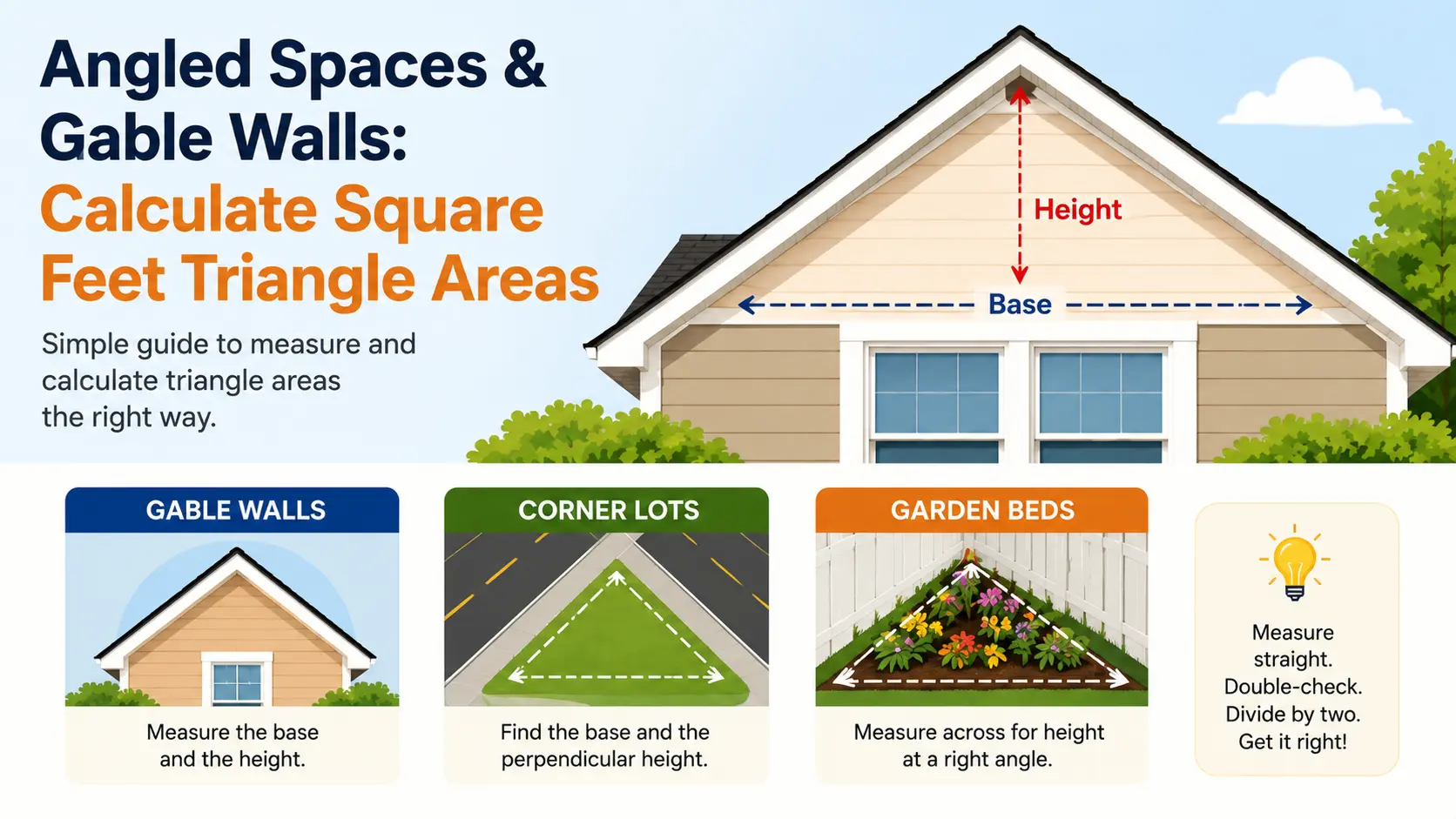
The Two Mistakes That Ruin Every Triangle Calculation
Most triangle calculation errors come down to two specific mistakes. Both are easy to make, and both throw the final number off by a wide margin.
Mistake 1: Forgetting to divide by two. The formula is ½ × base × height. That means you multiply base by height, then cut the answer in half. Skip that last step and you've calculated the area of a rectangle, not a triangle. A 40 square foot triangle becomes 80 square feet. That's a 100% error, not a rounding issue.
Mistake 2: Measuring the slanted side instead of the perpendicular height. The height in a triangle formula isn't the length of the slanted edge. It's the straight vertical distance from the base to the peak, measured at a perfect 90-degree angle. On a gable wall, the height is measured straight up from the base to the roofline's peak, not along the angled edge of the roof itself.
Both mistakes inflate the area. On a siding or roofing order, that inflation turns into wasted material and wasted money.
The Formula (½ × Base × Height) and Why It Works
Area = ½ × Base × Height
Any triangle is exactly half of a rectangle built on the same base and height. Multiply base by height, and you get the rectangle's area. Divide by two, and you get the triangle's area. That's the whole idea.
A triangle with a 10-foot base and an 8-foot height comes to half of 10 times 8, which is half of 80, or 40 square feet.
For triangle areas that need unit conversion or combine with other shapes, our area calculator handles the math automatically.
Gable Walls: The Most Common Real-World Triangle
A gable wall is the triangular section under a peaked roofline. The base is the width of the wall at its widest point. The height is the straight vertical distance from that base up to the peak. A gable wall with a 24-foot base and a 6-foot peak comes to half of 24 times 6, which is 72 square feet.
If you know the roof pitch but not the height, there's a shortcut: height = (span × pitch) ÷ 24. A 50-foot span with a 10/12 pitch gives you (50 × 10) ÷ 24 = 20.8 feet. Multiply that by half the span (25 feet), and the triangle comes to 521 square feet.
Add the triangular gable to the rectangular wall section below it for the wall's total square footage. For complete wall measurement guidance, our wall square footage guide covers subtracting doors and windows from the rectangular sections.
When You Can't Measure the Height: Heron's Formula
Sometimes measuring the perpendicular height isn't practical. An irregular corner lot with no clear apex. A triangular field where one side slopes. A garden bed tucked against a fence at an awkward angle.
For those, Heron's formula calculates area using only the three side lengths. First, find the semi-perimeter: s = (a + b + c) ÷ 2. Then plug into Area = √[s(s−a)(s−b)(s−c)].
For a triangle with sides of 300, 400, and 500 feet, the semi-perimeter is 600. The area works out to 60,000 square feet, or about 1.38 acres. The Byju's guide to Heron's formula walks through the derivation and more examples if you want the full breakdown.
Corner Lots, Garden Beds, and Roof Sections
Corner lots often form a triangle where two property lines meet at an angle. Measure the longest straight edge as your base, then measure the perpendicular distance to the opposite corner. A lot with a 120-foot base and an 80-foot height comes to 4,800 square feet, or about 0.11 acres.
Triangular garden beds follow the same formula. A bed with a 60-foot base along a fence line and a 40-foot perpendicular height comes to 1,200 square feet. Add 10% waste for mulch or soil, since edges and cuts always use a bit more.
Roof sections on hip roofs and dormers often include triangles. Each one gets measured and calculated on its own, then added to the total. For roof-specific guidance, our roof square footage guide covers those details.
Frequently Asked Questions
What is the formula for calculating triangle area?
Take the base, multiply it by the height, then cut that number in half. Just make sure that the height is measured straight up from the base.
How do I measure the height of a gable wall?
Stand at the base of the gable and measure straight up to the peak. Don't follow the roof's slope. The straight-up distance is always shorter than the slanted edge, so using the slant will give you a bigger number than you need.
Why is my triangle calculation coming out too large?
Two usual suspects: either you skipped the division by two, or you measured the slanted side instead of the straight-up height. Both make the area bigger than it should be. Double-check those two steps.
Can I use the triangle formula for any triangle?
Yep, it works for any triangle. Just pick a side as your base, then measure the height at a right angle to that base.
What if I can't measure the height directly?
If you can't get a straight-up height, Heron's formula is your backup. You only need the three side lengths. It's a bit more math, but it works for weird-shaped lots or fields where there's no obvious peak to measure from.
Conclusion
Triangle math comes down to one formula and two mistakes to avoid. Remember the division by two. Measure straight up for height, not along the slant. Get those right, and the calculation is simple.
For triangles, rectangles, circles, and other shapes, our area calculator handles the math directly.
Updated: September 2026