Roofing Math Made Simple: Calculate Square Feet of Roof for Shingles

A roofer quotes a job in "squares," not square feet, and suddenly the number on your invoice doesn't match anything you measured yourself. There's a reason for that gap, and it comes down to one thing most homeowners never think about: a roof's slope.

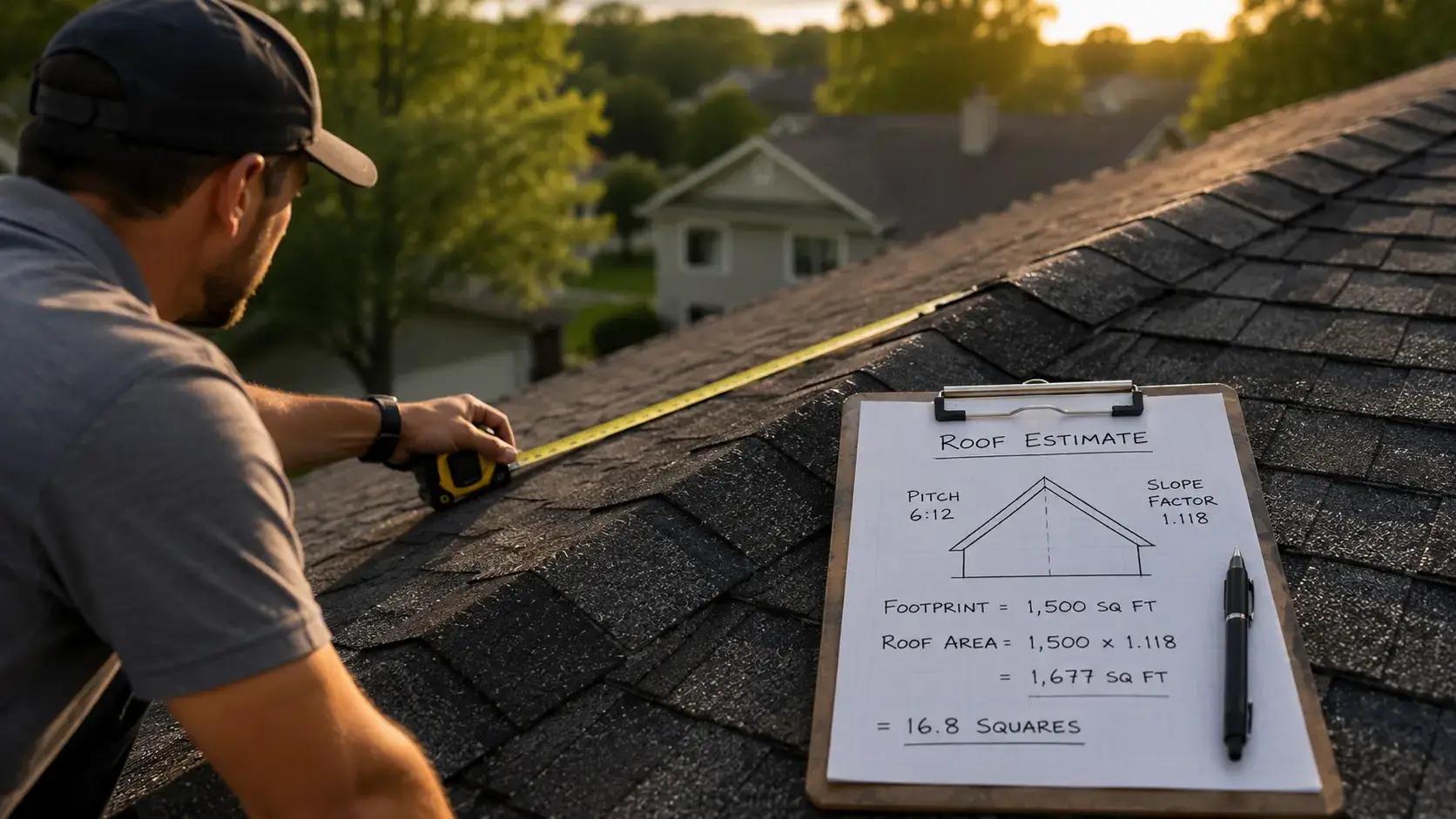
Gable roof diagram showing pitch ratio and slope factor used to calculate square feet of roof for shingle ordering

Here's how to calculate square feet of roof space accurately, why roofers use a different unit than everyone else, and how to avoid ordering the wrong amount of shingles.

If you're already comfortable with basic square footage calculations, our square footage formula guide covers the fundamentals before you start adding slope factors.

Why Roof Measurements Aren't Simple

A roof isn't flat like a floor. It slopes, which means the actual surface area is always larger than the footprint of the house below it. Measuring only the house's footprint and treating that as the roof's square footage undercounts the real number, sometimes by a lot depending on how steep the roof is.

This is the single biggest reason DIY roof estimates come out wrong. The math isn't hard once you know to include slope — it's just an easy step to miss if you've never done it before.

The Basic Formula, Then the Slope Adjustment

Start with the footprint. Measure the length and width of each roof section as if you were looking straight down from above, then multiply to get the flat footprint area.

That number isn't your final answer. Multiply it by a slope factor, which accounts for the roof's pitch. A flat or very low-slope roof might only need a small adjustment. A steep roof can add 40% or more to the footprint number once the slope factor is applied.

Understanding Roof Pitch

Pitch is usually written as a ratio, like 6:12, meaning the roof rises 6 inches for every 12 inches of horizontal distance. A steeper roof has a bigger first number. A 4:12 roof is fairly gentle. A 9:12 or 12:12 roof is steep.

Each pitch has a matching slope factor used to convert flat footprint into actual roof surface area. Roofing suppliers and contractors have standard tables for this, and most online roofing calculators build the pitch factor in automatically once you enter the slope.

How to Calculate Square Feet of a Roof, Step by Step

Measure the footprint of each roof section from below or from a set of building plans. Multiply length by width for each section. Add the sections together for a total footprint. Multiply that total by the slope factor matching your roof's pitch. The result is your actual roof surface area in square feet.

A simple gable roof with a 1,500 square foot footprint and a 6:12 pitch, for example, uses a slope factor of roughly 1.118, which brings the actual surface area to about 1,677 square feet. That's a meaningful difference from the footprint number, and it's exactly the gap that trips up a rough estimate.

Learning how to calculate square feet of a roof this way — footprint first, then slope factor — is the same basic process whether the roof is a simple gable or something more complex with multiple sections. The extra steps for complicated roofs come from breaking the shape apart, not from a different formula.

If you're measuring complex roof sections or an irregular building shape, our area calculator handles the basic square footage math before you apply the slope factor.

Tools for Measuring a Roof Safely

Getting up on a roof to measure it directly isn't always necessary, and for steep or high roofs, it isn't safe without proper equipment. Building plans, if available, usually list roof dimensions and pitch directly, which removes the guesswork entirely.

Satellite and aerial measurement tools, often used by roofing contractors and insurance adjusters, can estimate footprint and even pitch from overhead imagery without anyone climbing a ladder. For a rough DIY estimate, measuring the house's footprint from the ground and combining it with a pitch reading taken safely from an attic or a small section of visible roof edge is usually enough to get a reasonably accurate number.

A tape measure and a small level work for checking pitch on an accessible section — hold the level horizontally, measure how many inches the roof rises over a 12-inch horizontal run, and that ratio becomes the pitch used for the slope factor.

From Square Feet to Roofing Squares

Roofing materials are priced and sold by the "square," which equals 100 square feet — not to be confused with a square shape. Once you have your roof's total surface area, divide by 100 to get the number of squares needed.

A roof with 1,677 square feet of surface area needs about 16.8 squares, which rounds up to 17 for ordering purposes. Shingle bundles are typically sold three bundles per square, so that roof would need roughly 51 bundles before adding any waste factor.

Roof Waste Factor and Common Add-Ons

Roofing waste tends to run higher than flooring or wall waste, often 10 to 15% for a simple roof shape, and higher for roofs with lots of valleys, hips, or dormers. Cutting shingles to fit around chimneys, vents, and roof edges uses up material faster than a plain rectangular surface would.

Ridge caps, starter strips, and underlayment are usually calculated separately from the main shingle count, based on the roof's perimeter and ridge length rather than its total square footage. A roofing estimate that only accounts for the flat squares of shingles, without these extras, will come in lower than the real total material cost.

Roof Shapes and Their Extra Complexity

A simple gable roof, with two flat sloped sections meeting at a ridge, is the easiest shape to calculate. A hip roof, which slopes on all four sides, needs each section measured and adjusted separately since the sections aren't always the same size or pitch.

Roofs with dormers, valleys, or multiple roof lines at different heights need to be broken into individual sections, calculated one at a time, then added together — similar to how an irregular room gets split into rectangles before adding up the total.

If you're working with a circular or curved roof section, our circle area guide covers the radius-based math for non-rectangular shapes.

Common Roof Pitch Factors

Roof Pitch Slope Factor Approx. Extra Area
3:12 1.031 About 3% more than footprint
6:12 1.118 About 12% more than footprint
9:12 1.25 About 25% more than footprint
12:12 1.414 About 41% more than footprint

Common Mistakes When Estimating Roof Area

  • Using the house's footprint as the roof's square footage. This ignores slope entirely and almost always undercounts the real surface area.
  • Forgetting to convert to squares before ordering. Shingles are priced by the square, not the square foot, so skipping this conversion leads to confusion when comparing quotes.
  • Not accounting for roof complexity. Valleys, hips, and dormers add both surface area and waste, beyond what a simple gable roof calculation accounts for.
  • Leaving out ridge caps and starter strips. These are priced separately from the main shingle count and are easy to forget when budgeting a total material cost.
  • Measuring from the ground instead of an accurate source. Estimating roof dimensions by eye from the ground is far less accurate than working from building plans or an actual roof measurement.

Why Getting This Right Matters

An underestimated roof order means a second delivery mid-project, and roofing materials often need to be ordered from the same batch to avoid slight color variation between bundles. A steep roof with a wrong pitch factor can throw off a material order by a large enough margin to delay the whole job by days while more shingles are sourced.

Insurance claims and contractor quotes also rely on accurate roof measurements. A homeowner who tries to verify a roofing quote using only the house's footprint, without adjusting for pitch, will almost always come up with a lower number than the roofer's estimate — not because the roofer is padding the number, but because the footprint was never the right starting point.

Comparing Multiple Roofing Quotes

When comparing quotes from different roofers, the square footage or number of squares listed should be reasonably close between them, assuming both measured the same roof accurately. A big gap between two quotes' stated square footage is worth asking about directly, since it usually means one of them measured differently, included or excluded certain sections, or made an error somewhere in the pitch calculation.

What's harder to compare directly is the price per square, since that number includes labor, tear-off of old shingles, disposal, and material quality, on top of the raw square footage. Two quotes with nearly identical square footage can still land far apart in total price for reasons that have nothing to do with the roof measurement itself — similar to how flooring or paint quotes can vary even when the underlying square footage matches.

For more on comparing quotes and understanding price per square foot, our square footage price guide covers the basics of material vs. installed costs.

FAQs

How do I calculate square feet of a roof from the ground?

It's difficult to do accurately from the ground alone. Most reliable estimates start from building plans or an actual roof measurement, then apply the pitch's slope factor.

Why is my roof's square footage larger than my house's footprint?

Because a roof slopes rather than lying flat. The steeper the pitch, the more the actual surface area exceeds the flat footprint below it.

What's the difference between a roofing square and a square foot?

A roofing square equals 100 square feet. Roofing materials are priced and ordered by the square, not by individual square feet.

How much extra material should I order for roof waste?

Typically 10 to 15% for a simple roof. More complex roofs with valleys, hips, or dormers often need closer to 20%.

How do I find my roof's pitch?

Pitch is usually available on building plans, or can be measured directly using a level and a tape measure along a section of the roof.

Do all sections of a roof have the same pitch?

Not always. A roof with dormers or different rooflines can have one pitch here and another pitch there, so you have to work out each section on its own.

How many shingle bundles are in one roofing square?

Most brands put three bundles in a square, but it can change a bit depending on the shingle style you go with.

Should I include the roof overhang in my square footage calculation?

Yes. Since the overhang hangs past the walls and still needs shingles, you should include it when you measure the footprint — before you multiply by the slope factor.

Can I use the same calculation method for a flat roof?

Flat or very low-slope roofs need a much smaller slope factor adjustment, since there's minimal difference between the footprint and the actual surface area.

Getting an Accurate Roof Estimate

The footprint is only the starting point. Slope factor, roof shape, and waste all shift the real number needed for a roofing project, and skipping any of these steps is why DIY roof estimates so often come in lower than what a professional quote reflects.

For flat, rectangular surfaces like walls, floors, or simple roof sections, our area calculator handles the basic square footage — just remember that roof surface area still needs a slope factor applied on top of that flat measurement.

Scroll to Top