
Square Feet of a Circle: The Only Number You Actually Need
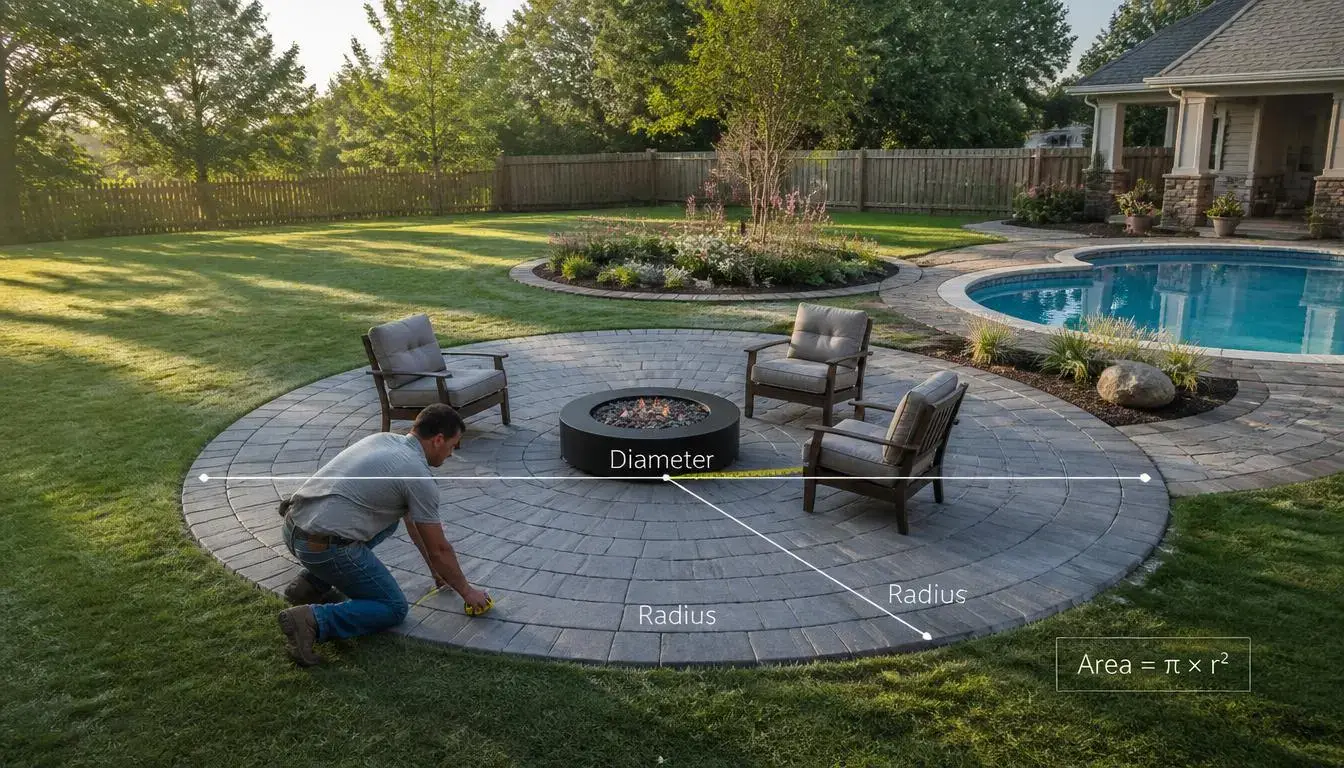
How do you calculate square feet of a circle? You only need one number: the radius. But most people grab the diameter instead. That single mix-up makes the area come out four times too big. Get the radius right, and the rest is simple multiplication: π × r². That's it.
Pools, patios, garden beds, fire pit areas. Whenever someone needs to calculate square feet of circle spaces, the answer hinges on getting the radius right. Not two straight-line measurements like a rectangle needs. Just one. Get that one number right, and everything else is a single multiplication.
The Radius vs. Diameter Mistake (And Why It Costs You 4x)
The diameter runs straight across the whole circle, through the center. The radius is half that distance, from center to edge. Easy to confuse the two, especially with a tape measure in hand.
Stretch a tape measure straight across a circular space and you'll naturally land on the diameter. Use that diameter where the formula wants a radius, and the area doesn't come out a little off. It comes out roughly four times too big. Why? Because the radius gets squared, and squaring the wrong number squares the mistake too.
So if your tape reads 12 feet across, divide by two before you do anything else. That gives you a 6-foot radius. Skip that step and a 113 square foot circle balloons into a wrong number (452 square feet), which is more than enough to wreck a material order. Research on circle calculation errors confirms this is the most common conceptual mistake people make, appearing in both academic studies and practical how-to guides.
The Formula (π × r²) and Why It Works
Area = π × Radius²
Pi (π) sits at roughly 3.14, and it never changes. Small circle, huge circle, doesn't matter. The radius is the distance from dead center out to the edge. Square it, multiply by pi, and you've got your area in square feet.
Take a circle with a 6-foot radius. π × 6² works out to π × 36, which lands at 113.1 square feet. One measurement. One formula. Done.
Need to convert between square feet, square yards, or square meters? Our square footage calculator handles circle inputs automatically and does the unit conversion for you.
For a deeper dive into the formula, Maths Is Fun's circle area guide breaks it down with interactive examples.
Measuring a Circle in 3 Steps
Step 1: Measure the diameter. Stretch a tape measure across the widest point of the circle, straight through the center.
Step 2: Cut it in half. That gives you the radius. An 8-foot-wide garden bed has a diameter of 8 and a radius of 4.
Step 3: Square it, multiply by π. 4 squared is 16. 16 × 3.14 is 50.3 square feet.
Bigger circles need a different trick. Stake a piece of string at the center, stretch it to the edge, and read off the radius directly. No diameter guesswork required.
Pools, Patios, and Garden Beds: Same Formula, Different Numbers
Round pools get sized by diameter almost every time. A "15-foot pool" means 15 feet across, not a 15-foot radius. Divide by two first. A 15-foot pool has a radius of 7.5 feet, which works out to 176.7 square feet. A 24-foot pool has a radius of 12 feet, landing at 452.4 square feet. Keep surface area and water volume separate in your head. One tells you how much ground the pool covers, the other tells you how much water it holds.
Circular patios built from pavers use the same formula, but budget for extra material. Curved edges mean cuts. A radial fan pattern typically needs 15–20% extra for waste, while concentric ring layouts waste less, around 8–12%. The smaller the patio, the higher the waste percentage tends to run.
Garden beds and tree rings are forgiving. A 6-foot-wide bed has a 3-foot radius, which gives you 28.3 square feet. A rough radius with a tape measure or string gets close enough for mulch or soil.
When You Only Know the Circumference
Sometimes wrapping a tape measure around something is easier than measuring across it. That distance is the circumference, and turning it into a radius takes one more step:
Radius = Circumference ÷ (2 × π)
A 31.4-foot circumference works out to a radius of exactly 5 feet. Run that through the area formula and you land at roughly 78.5 square feet. You can also skip straight to the area with this formula: Area = Circumference² ÷ (4π). Same answer either way.
Half-Circles, Quarter-Circles, and Slices
Not every curve is a full circle. A half-circle patio against a straight wall. A quarter-circle bed tucked into a corner. All slices, not whole circles.
The approach stays the same: work out the full circle's area first, then take the right fraction. A half-circle with a 6-foot radius gets half of 113.1 square feet, so about 56.5. A quarter-circle with that same radius lands around 28.3. Got an odd-angled slice? Multiply the full circle's area by the angle, then divide by 360. A 90-degree slice is exactly a quarter.
Mistakes That Throw Off Circle Area (And How to Avoid Them)
Beyond the radius-versus-diameter mix-up, a few other errors show up again and again. Rounding pi down to 3 feels harmless until you're working with a large circle, where that small rounding compounds into a real error. Mixing inches and feet halfway through is another quiet killer. Radius in inches has to become feet before it touches the formula.
And one more: treating an oval like a perfect circle. Hand-built garden beds and patios drift oval more often than you'd think. Fine for a rough mulch estimate. Not fine for an exact paver order. Measure the radius from a few directions and average them if precision matters.
Frequently Asked Questions
How do I find the area of a circle if I only know the diameter?
Divide the diameter by two to get the radius, then use π × r². A 12-foot diameter gives you a 6-foot radius and 113.1 square feet.
Why does using diameter instead of radius make the area four times too big?
Because the formula squares the radius. Diameter is twice the radius, so plugging it in squares that doubling too, and the area comes out roughly four times too big.
Can I work out a circle's area from just its circumference?
Yes. Divide the circumference by 2π to get the radius, then use the standard formula. Or use Area = Circumference² ÷ (4π) directly.
Do round patios need extra material for cutting?
Yes, 15–20% waste is standard for radial fan patterns. Concentric ring layouts waste less, around 8–12%. Curved edges mean more cuts than straight-edged patios.
For circles, rectangles, triangles, and L-shaped rooms alike, our area calculator handles the radius-based math automatically. Enter the measurement, and the squaring and multiplying by pi happen without you touching a calculator.
Updated: September 2026