Yard Square Footage: Sod, Mulch & Seed Without the Guesswork
To calculate square footage yard projects, split the yard into measurable shapes, add their areas together, then subtract non-grass areas like patios and garden beds. For sod, add a 5–15% waste buffer. For mulch, multiply square footage by depth. For seed, check the bag for coverage rate per 1,000 sq ft. Get these numbers right, and you'll order exactly what you need.
Ordering sod for a backyard feels straightforward until the delivery shows up short, or worse, with three extra pallets sitting on the driveway with nowhere to go. Yard projects run into the same square footage issues as any other project, plus a few that are unique to grass, mulch, and open outdoor space.
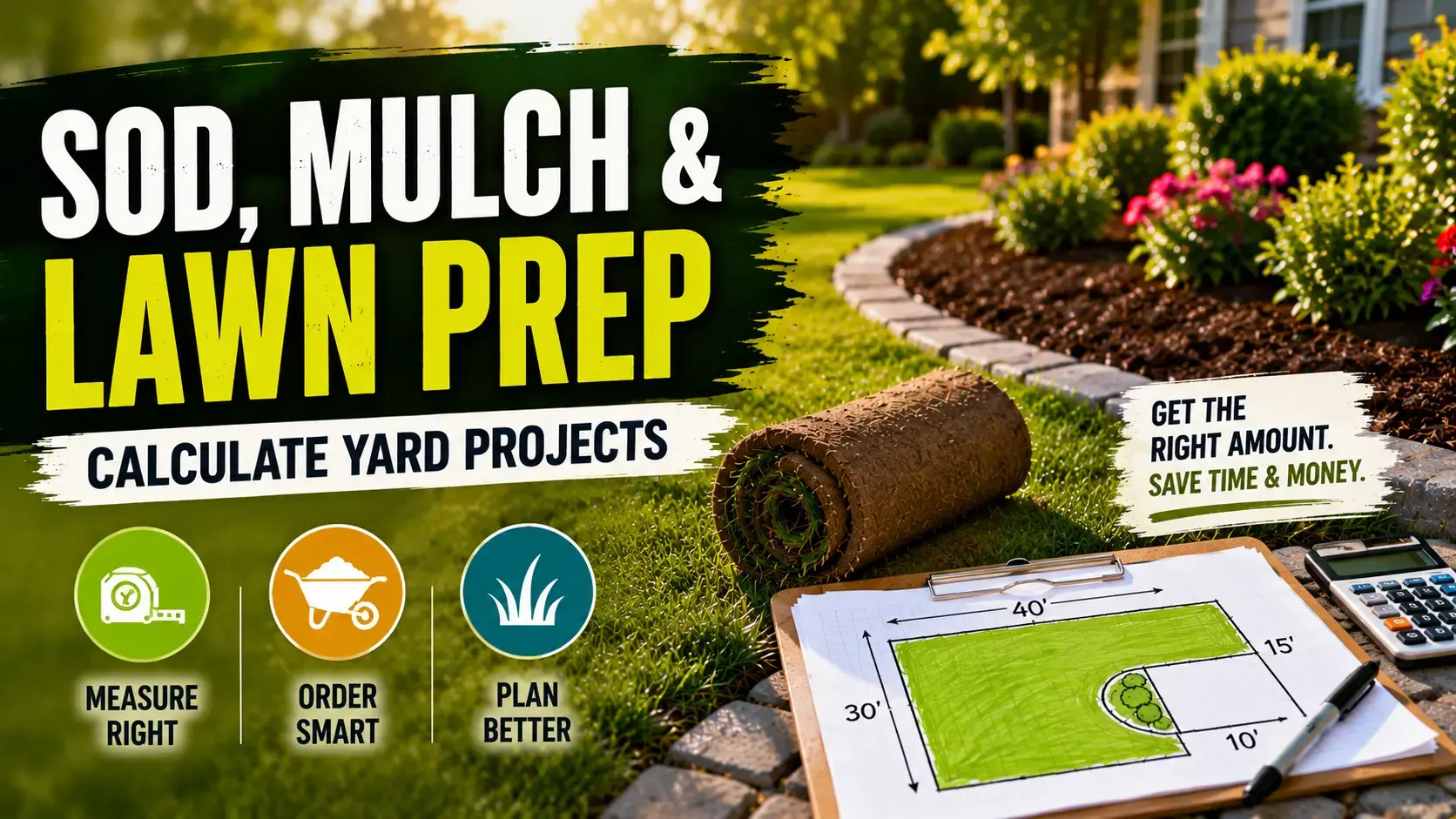
Measuring Your Yard in Three Steps
Most yards aren't a clean rectangle. The approach that works: split the space into shapes you can actually measure, subtract what isn't grass, then apply the right coverage rule for your material.
Step 1: Break the Yard Into Measurable Shapes
Sketch the yard first. A rough drawing helps you see where the shape bends or narrows. Then break it into rectangles, triangles, and circles. A rectangular main lawn might be one section. A curved flower bed is a circle. An angled corner is a triangle.
For rectangles, multiply length × width. Triangles use ½ × base × height. Circles use π × radius². Add all the sections together. For a detailed walkthrough of measuring irregular spaces, our room measurement guide covers the same process used indoors.
Step 2: Subtract Non-Grass Areas
Patios, pools, walkways, garden beds, and driveways all need to come out of the total. Measure each one separately, then subtract. A 1,750 sq ft yard with a 113 sq ft circular patio and a 100 sq ft garden bed leaves 1,537 sq ft of actual lawn area.
Forgetting this step is the most common reason sod orders run high. You end up paying for grass that was never going down. Our square footage overview covers the basics if you need a refresher on the formula.
Step 3: Apply the Right Coverage Rule
Sod: Rolls cover about 10 sq ft each; pallets cover 400–500 sq ft, with 450 being the most common average. Add 5% waste for simple rectangles, 10–15% for curves or L-shapes. Round up, because partial pallets aren't sold.
Mulch: Coverage depends on depth. One cubic yard covers 162 sq ft at 2 inches deep. A 200 sq ft bed at 2 inches needs about 1.2 cubic yards. Double the depth, double the material.
Grass seed: New lawns need 5–8 lbs per 1,000 sq ft for most cool-season grasses. Overseeding uses half that rate. Shady or high-traffic areas need 25–50% more.
Why Yard Measurements Go Wrong
Most yard measurement mistakes come down to four things. Eyeballing instead of measuring. Skipping the subtraction step. Treating mulch like a flat area calculation when it's really about volume. And assuming every sod pallet covers the same square footage. They don't.
Pallet coverage varies by supplier and region. Florida farms often cut 400 sq ft pallets; some Midwest suppliers run 500. Check the specific product before you order, not after.
Sod vs Seed: A Quick Reality Check
Sod gives you an instant lawn. It's delivered in rolls or pallets, laid down in a day, and rooted within two to three weeks. Material costs run $0.35–$0.85 per sq ft, and installation adds more if you hire it out.
Seed is cheaper upfront (around $0.07–$0.24 per sq ft), but takes weeks to establish. It's better for large areas where sod would be cost-prohibitive, and better for slopes where erosion control matters. Sod handles slopes better, but seed can work if you add a straw blanket or erosion netting.
Sloped Yards Need Extra
A sloped yard has more surface area than its flat, top-down footprint suggests. For gentle slopes, add 5% beyond your normal waste factor. For steeper grades, add 10%. On very steep slopes, measure along the actual slope length rather than the flat distance. The difference matters more than most people expect.
A Real Yard, Worked Out
Say a backyard measures 50 feet by 35 feet. That's 1,750 sq ft. Subtract a 113 sq ft circular patio and a 100 sq ft garden bed. You're left with 1,537 sq ft of actual lawn.
At 450 sq ft per sod pallet, that's 3.4 pallets. Add 5% waste for simple shapes, and you're at 3.6 pallets. Round up to 4. Skip the subtraction and you'd order for 1,750 sq ft instead, over-ordering by roughly half a pallet.
One Question Most People Forget to Ask
"What if my yard has a shape I can't easily split into rectangles?"
Use the offset method. Measure offsets at right angles along the longest axis, then calculate the average width and multiply by length. It's accurate to within about 5% for most residential yards, which is close enough given the waste factor already built in.
For flat sections like rectangular lawns or garden beds, our area calculator handles the square footage directly. It doesn't subtract patios or beds for you, so do that manually before ordering. For curved sections like circular beds or a round patio, our circle area guide covers the formula.
Updated: September 2026