
What Are Baby Names From Parents? 4 Ways to Honor Both Sides
Baby names from parents are names created by blending, combining, or drawing inspiration from both parents' names to honor both sides equally. Whether you merge syllables, use initials, place a parent's name as a middle name, or choose a name whose meaning connects both families, there are multiple ways to give your child a name that carries a piece of both of you.
You are expecting. And the first question everyone asks is: "Have you picked a name yet?" Then comes the harder question: "Whose side gets honored?"
5 Mistakes Parents Make When Choosing a Baby Name from Both Sides
Even with the best intentions, parents often make mistakes when trying to honor both sides. Here are the most common ones and how to avoid them.
- Not checking how it sounds with the last name. A blend can sound great alone but awkward with your surname. Say the full name out loud before deciding. Considering a blended last name too? See our surname combiner guide.
- Accidentally landing on an existing name. Some blends already exist with their own associations. Not necessarily bad, but worth knowing before you commit.
- Ignoring sibling consistency. If you already have a child with a traditional name, a heavily blended second name can feel mismatched.
- Forcing a blend when the names don't fit. If you have tried ten variations and nothing sounds right, try using a nickname version of one name instead. "Rebecca" might not blend, but "Becca" usually does.
- Chasing uniqueness for its own sake. According to a University of Michigan-led study published in Nature Human Behaviour, common names are fading 2-6% a year while rare names are climbing 1-3%. It is a real shift, but not a reason to pick something so unusual it becomes a lifelong spelling correction.
4 Ways to Honor Both Parents in a Baby Name
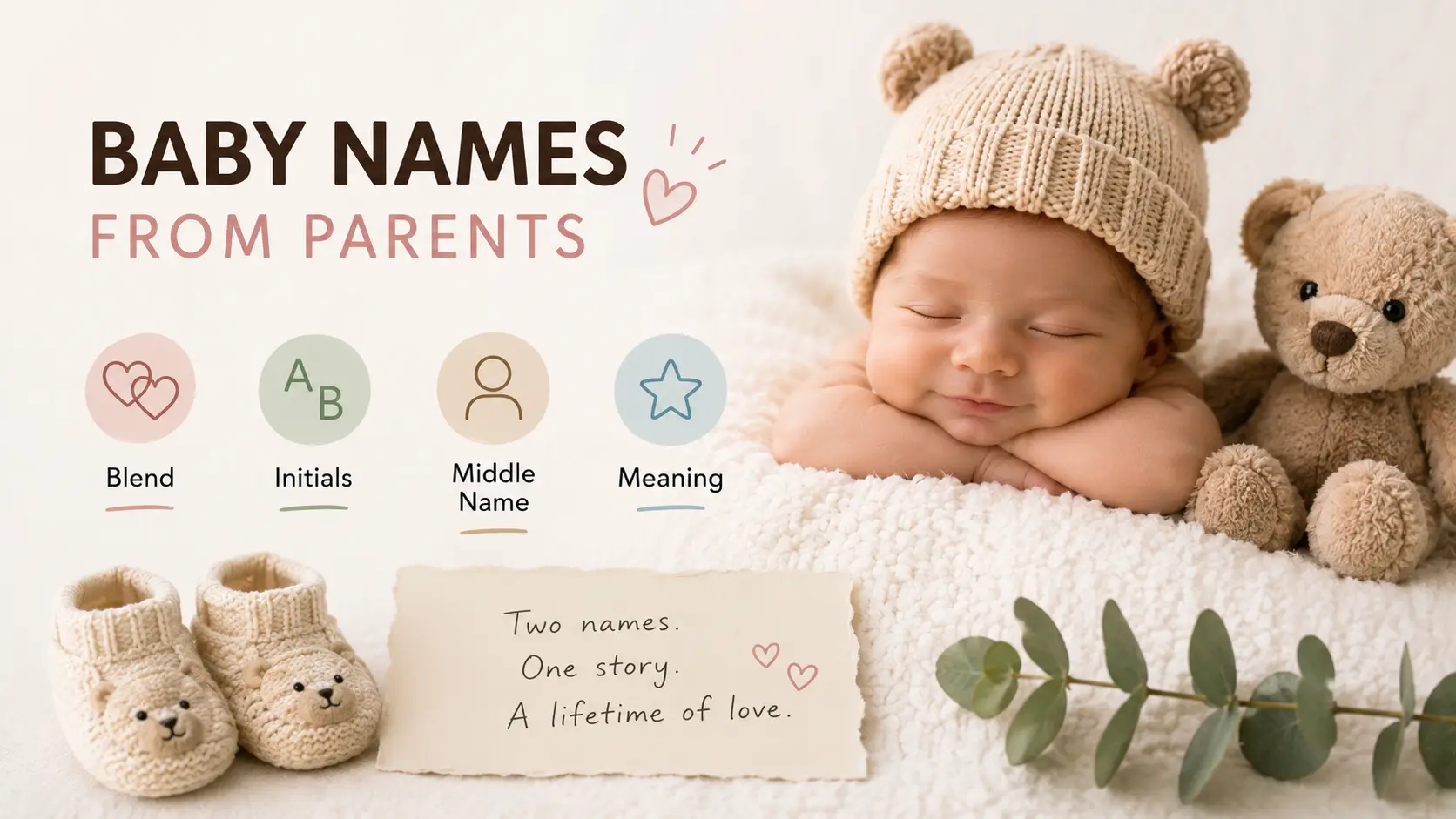
Most online guides assume you want to blend names. Michael and Sarah becoming Micah. But that is just one route. Here are four approaches parents actually use:
| Approach | How It Works | Example | Best For |
|---|---|---|---|
| Full Blend | Both names merged into one new name | Aisha + Rohan → Airohan | The most obvious option |
| Initial-Based | Baby name starts with one parent's letter, or initials spell something meaningful | Owen + Naomi → Nora (from O.N.) | Subtle, no explanation needed |
| Middle-Name Placement | One parent's name becomes the baby's middle name | Michael + Rebecca → First name chosen + Michael as middle | Sidesteps the pronunciation question |
| Meaning-Based | Choose a name whose meaning connects to both parents' names | "Light" + "Gift" → Gift of Light | Travels better across cultures |
None of these is better than the others. The right one depends on whether you want the connection obvious or something only your family knows.
How to Blend Parent Names for a Baby Name
If you want the obvious version, a name combiner is what you need. Set the purpose to Baby and it works differently than couple or business modes. Results come back labeled by gender feel — girl-leaning, boy-leaning, or unisex.
A few things worth adjusting before you generate:
- Enter full first names, not nicknames — more syllables give you better options.
- Try More First Name or More Second Name if one side should lead.
- Keep max length around six to eight characters. Real baby names sit in that range.
- Add a grandparent's name as a third input if you want their side represented too — the tool blends all three. See our combine 3 names guide for more.
Most parents assume the first result is the safest. It usually is not. The earliest results tend to be the most literal, letter-for-letter blends — and those often sound like mashups instead of real names.
Real Baby Name Blends — Before & After
| Parent Names | Blended Result | Approach |
|---|---|---|
| Aisha + Rohan | Airohan or Rohaisha | Full blend, keeps both roots audible |
| Aarav + Priya | Aariya or Priyav | Full blend, unisex-leaning |
| Kevin + Priya | Keviya or Priyevin | Cross-cultural full blend |
| Michael + Rebecca | First name chosen + Michael as middle | Middle-name placement |
| Owen + Naomi | Nora (from initials O.N.) | Initial-based, not a syllable blend |
Beyond Blending — 3 Other Ways to Honor Both Parents
Initial-Based Names
Works well when both names start with strong, distinct letters. Some parents pick a name starting with one parent's initial. Others get more creative — the full name's initials spell something intentional, like a shared word or family in-joke. It is subtler than a blend, and nobody needs it explained at a dinner party.
Middle-Name Placement
This sidesteps the pronunciation question entirely. The baby gets a first name you both love, and one parent's name — sometimes shortened, sometimes exact — becomes the middle name. It is probably the most common approach in practice, since it does not require either name to bend into something new.
Meaning-Based Naming
This takes the most research but often produces the most lasting result. If one parent's name means "light" and the other's means "gift," a name meaning "gift of light" connects both without either name being audible. It also travels better across cultures and languages, since you are matching concepts instead of sounds.
The 7-Day Name Test
Before you commit, test your shortlist for a week. Here is how:
- Say it with the last name, out loud, more than once. Reading it silently hides awkward sound collisions.
- Check the initials. Spell them out. Make sure they do not accidentally spell something you would rather avoid.
- Ask both families to say it back. If grandparents stumble consistently, it may need a simpler version.
- Sit with your shortlist for a week. The name that still feels right after a week usually holds up better than the one that felt exciting on day one.
Frequently Asked Questions
What is a baby name from parents?
Any name built to reflect both parents — through a blend, shared initials, a middle-name placement, or a meaning that connects both names.
Do I have to blend the names together?
No. Blending is just one option. Using a parent's name as the middle name, or choosing a name with a related meaning, works just as well and is often easier to say.
Can I include a grandparent's name too?
Yes. Add a third name as an input and the blend draws from all three instead of just the parents' names.
How do I know if a blended name sounds natural?
Say it with the last name attached, more than once, to people outside your household. If it needs spelling out, it is probably not ready.
Does this work for cross-cultural or multilingual name pairs?
Yes. Meaning-based naming in particular works well here, since it connects the names' meanings rather than forcing sounds to blend.
What if we cannot agree on a name?
Shortlist three or four favorites, say them out loud together, and give it a week. Sometimes hearing a name in context helps settle the decision.
How do we choose between blending, initials, middle name, or meaning?
Think about how obvious you want the connection to be. Blending is most obvious; meaning-based is quietest. Choose what fits your family's style.
Want the couple-name version instead? See our couple name maker guide.
Try Our More Tools
- Wedding Hashtag Generator – unique hashtags for your special day
- Band Name Generator – catchy band names for any genre
- Team Name Generator – team names for sports, gaming, and work
- Book Title Generator – compelling titles for your next book
- Gamertag Generator – a unique gaming identity
- Word Combiner – merge regular words for content ideas
Updated: August 2026 · Part of the FreeToolsValley suite of free online tools for creators.