
Surname Combiner: How to Blend Two Last Names Into One Shared Family Name
You're engaged. You both want to share a last name, but neither of you wants to give yours up entirely. Hyphenating feels long and clunky. Taking one partner's name feels like one side is losing something. That's where a surname combiner comes in — a tool that blends two last names into one new family name that actually works. It's the same portmanteau logic behind Brangelina, but applied to your legal identity instead of your Instagram bio.
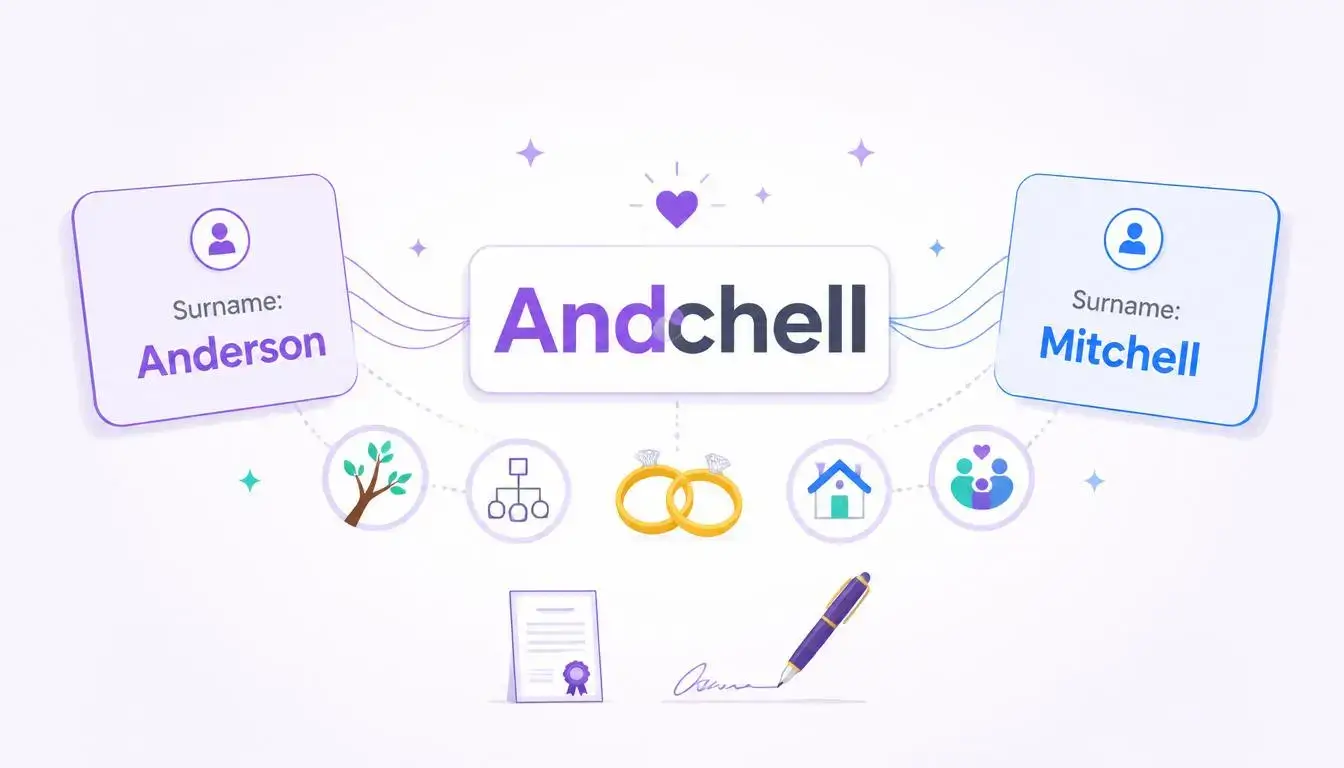
This guide covers everything you need to know: how a last name combiner works, real examples, legal considerations, and what to expect if you decide to go through with it.
Surname Combiner vs. Hyphenation — Which Is Right for You?
Most couples default to hyphenating because it feels like the safe, obvious choice. According to a 2023 Pew Research Center survey, about 79% of women in opposite-sex marriages took their husband's last name, 14% kept their own, and just 5% hyphenated. Blended surnames didn't even register as a separate category. That's not a reason to skip it — it's a reason to get it right.
Here's the difference: a hyphenated name keeps both surnames fully intact. A blended surname merges the two into something new. Neither is objectively better — they just solve different problems.
| Option | Best For | Key Benefit | Limitation |
|---|---|---|---|
| Hyphenated Surname | Couples who want both family names visible | Keeps both names legally intact | Long on forms; often gets shortened over time |
| One Partner's Name | Couples who want the simplest option | Nothing new to explain or spell out | One family's name disappears from the record |
| Double Surname (No Hyphen) | Couples who want both names, cleaner look | Reads as one unit, no punctuation | Still long; word order can spark disagreement |
| Blended Surname | Couples who want a shared, new identity | Short, pronounceable, uniquely theirs | Loses direct traceability to either original name |
How a Surname Combiner Actually Works
First names are short and easy to blend — three or four syllables, one clean vowel to break on. Surnames are different. They run longer, carry consonant clusters (think "-strom," "-gaard," "-zewski"), and often come from languages where the "natural" break point isn't obvious to an English speaker just reading the letters.
Most online tools just cut each name exactly in half and glue them together. That's why they produce garbage like "Delowski" instead of something usable. A proper surname combiner reads each name by syllable — identifying where vowels sit, where consonants cluster, and where the rhythm naturally breaks. Then it rebuilds the blend around that flow.
Here's how to use it:
- Enter both last names into the combiner.
- Set the purpose to Couple — this ensures results are tailored for surname blending.
- Pick a combination style — Equal Mix balances both names evenly; More First or More Second lets one side lead.
- Pull the max-length slider down if you want something short (six to eight letters is ideal).
- Generate up to fifteen options, each with a syllable breakdown underneath so you can hear how it's meant to be said.
Shorter surnames tend to produce cleaner blends — there's simply less to balance. If both surnames run long, drag that slider down before you generate instead of trying to trim the output afterward.
Real Surname Blends — Before & After
Here are six real examples of how two surnames can be blended into something new, using the same logic our surname combiner applies automatically:
| Partner 1 Surname | Partner 2 Surname | Blended Result | Why It Works |
|---|---|---|---|
| Anderson | Whitfield | Whitderson | Keeps a recognizable opener and ending from each |
| Delgado | Kowalski | Delkowski | Smooth handoff at a natural consonant break |
| Reyes | Bergman | Reygman | Short and easy to say on the first try |
| Osei | Fitzgerald | Osgerald | Both cultural roots stay audible in the result |
| Nakamura | Sullivan | Nakalivan | Balances both names' rhythm instead of favoring one |
| Petrov | Chastain | Petrain | Trims both down to something clean and short |
Notice how each blend stays under nine letters, even though some of the original surnames run much longer. That's what happens when you blend by syllable, not by letter count.
Beyond Blending — Other Family Name Ideas to Consider
A full blend isn't the only option. Some couples choose alternative approaches that still honor both sides without merging into one word.
- Double Surname (no hyphen): Both last names side by side, no punctuation — like "Anderson Whitfield." Cleaner than a hyphen, but still long.
- One Legal Name, One Everyday Name: Keep one name for legal documents and use a blended or hyphenated version socially. Sidesteps the paperwork entirely.
- Middle Name as Surname: Move one partner's last name to the middle name slot and take the other's surname. Both names stay in the record.
- Initial-Based Name: Use first initials of both surnames to create something new — like "A.W." for Anderson + Whitfield.
If you're not sure which path to take, run a few surname pairs through the combiner using both Equal Mix and More First/Second settings. You'll see a spread — from barely changed to almost unrecognizable — and most couples end up choosing something in the middle rather than either extreme.
Why Surname Blending Is Growing in 2025-2026
Modern couples are increasingly looking for alternatives to traditional naming conventions. A few trends are driving this shift:
- Gender equality: More couples want a name that represents both partners equally, rather than defaulting to the husband's or wife's surname.
- Blended families: When two families merge after remarriage, a shared surname can symbolize unity without erasing existing family names.
- Social media identity: A unique, short surname stands out on digital platforms and is often easier to claim as a username.
- Legal awareness: More couples know they can create a new surname through marriage paperwork, so they're exploring options they didn't know existed.
- Professional branding: Some couples want a name that works for both personal and professional identities — short, memorable, and free of punctuation.
According to 2025 marriage data, surname blending is still a niche choice — but it's growing. What was once considered unconventional is becoming a practical, intentional alternative to hyphenation.
The Legal Side of Blending Surnames — What to Expect
If you're considering a blended surname, here's what to expect from the legal process:
- Check your state or country's rules. In many U.S. states, you can create a new surname directly through your marriage license paperwork. Others require a formal court petition. Check with your local vital records office or county clerk before filing.
- File the paperwork. If allowed through marriage, you'll list your new surname on the marriage license application. If not, you'll file a separate legal name change petition, which involves forms, a filing fee, and sometimes a waiting period.
- Update your Social Security card (if in the U.S.), then your driver's license, passport, and other government IDs. This can take several weeks, especially with a self-created surname that didn't exist before.
- Notify your workplace, banks, and insurance. Once your legal documents are updated, let the rest of the world know — your employer, financial institutions, and any other official accounts.
A quick call to your local vital records office before the wedding saves a lot of after-the-fact paperwork headaches. What most guides skip is the timeline — even in states where it's straightforward, updating everything can take four to eight weeks longer than a standard name change because some agencies ask for extra documentation.
Disclaimer: This guide covers the naming and pronunciation side of surname blending. It doesn't replace legal advice on what your specific state or country allows. Check with your local vital records office or a family law attorney before you file anything.
5 Common Mistakes That Make Surname Blends Unpronounceable
Even the best surname combiner can't fix bad inputs. Here are the most common mistakes people make — and how to avoid them:
- Cutting the name exactly in half. It's the first instinct, and it's usually why the result sounds clunky. The cut lands mid-consonant-cluster instead of at a natural syllable break. Always break at a syllable, not a letter count.
- Going too long. Surnames start longer than first names, so a naive blend often ends up nine or ten letters deep. Six to eight letters is the range that's actually easy to say and spell from memory.
- Skipping the read-aloud test. A blend can look fine on screen and still trip you up the first time you introduce yourselves at a dinner party. Read it out loud to someone who hasn't seen it spelled out before.
- Ignoring accent differences. If either partner has a family member who speaks with a different regional or non-English accent, say the blend out loud with them before you settle on it — not just with each other.
- Falling in love before checking availability. If you're using this as a social media handle or a business name, search it first. There's nothing worse than committing to a unique surname and finding out someone else already has it on every platform.
Frequently Asked Questions
Is it legal to combine two last names when you get married?
In most U.S. states, yes — you can create a new surname through your marriage license paperwork. However, exact rules and fees vary by state and country. Check with your local vital records office before filing.
Can unmarried couples create a blended surname together?
Yes, but it usually requires a formal legal name-change process through court, since there's no marriage license to attach the change to. This typically involves additional paperwork and a filing fee.
How do I combine last names without making it hard to pronounce?
Keep the blend under eight letters, break at a natural syllable instead of the exact midpoint, and read it out loud before you commit. If you stumble, the cut point is wrong.
What's the difference between a blended surname and a double surname?
A double surname places both original last names side by side with nothing removed. A blended surname merges the two into one new word. Double surnames keep both names intact; blended surnames create something new.
Do both partners have to agree on the blended name?
Yes — since it becomes both people's legal name, most marriage license offices expect a joint decision, not one partner choosing on their own. It's a shared identity, so it should be a shared decision.
How long does the name-change process take?
It varies by state, but even in straightforward states, updating Social Security, passport, and driver's license can take four to eight weeks longer than a standard name change. Some agencies ask for extra documentation because the name didn't exist before.
What if we can't decide on a blended surname?
Run a few pairs through the name combiner using Equal Mix, More First, and More Second settings. Shortlist three or four favorites, then say them out loud together. Sometimes hearing a name in context helps settle the decision.
Ready to Create Your Blended Surname?
Run your own last names through the surname combiner, set the purpose to Couple, and generate a batch before you settle on anything. Already have a couple name picked out? Our couple name maker guide covers first-name blending in more detail, and the wedding hashtag generator turns whatever name you land on into a full set of hashtag options for the big day. Naming a business instead of a family? Our business name combiner covers that version.
Updated: August 2026 · Part of the FreeToolsValley suite of free online tools for creators.