How to Calculate Square Footage Price: A Realist's Guide to Project Budgeting
To calculate square footage price, multiply the total area in square feet by the price per square foot. But that simple formula only gets you so far. The real challenge is understanding what goes into that price: labor, materials, waste, and the hidden costs that separate a cheap quote from a realistic one.
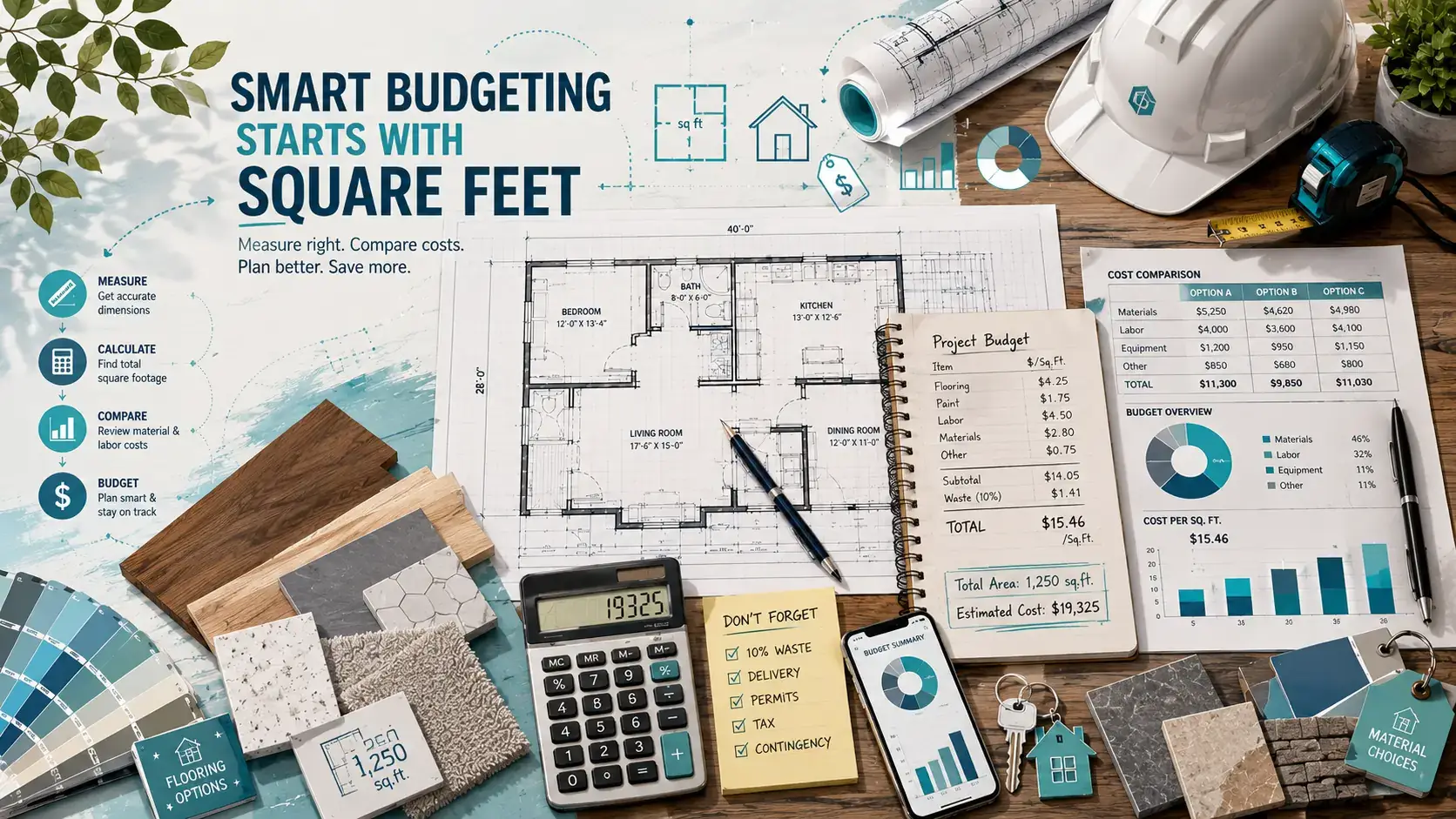
What "Price Per Square Foot" Actually Means
That number can mean two very different things. Material price per square foot covers only the product: a box of tiles, a gallon of paint. Installed price per square foot includes labor, waste, and often removal of old materials. Mixing them up is the fastest way to blow your budget.
Even installed prices aren't created equal. A simple, open room costs less per square foot to work on than a bathroom packed with fixtures, tight corners, and cut-ins around windows. Same square footage, very different labor hours.
If you need to nail down your measurements first, our guide on measuring a room walks through the process. And for the raw formula, the square footage formula guide covers the basics.
A Three-Step Framework for a Realistic Budget
Step 1: Find Your Total Area
Measure each room, multiply length × width, and add the totals. For irregular shapes, split them into rectangles. This is your starting number, the one you'll multiply against price per square foot.
Step 2: Establish a Realistic Base Price
Use current 2026 ranges as a starting point. These are material-only prices; labor is separate.
| Material | Price Range (per sq ft) |
|---|---|
| Laminate flooring | $1 – $5 |
| Hardwood flooring | $6 – $12 |
| Ceramic/porcelain tile | $2 – $15 |
| Interior paint | $1 – $3 |
Step 3: Add the Contingency "Waste Factor"
Never order exactly what you measured. Standard layouts need 5–10% extra for cuts and mistakes. Complex layouts or DIY jobs? Bump that to 15%. A 200 sq ft room with 10% waste means ordering 220 sq ft.
What the 300 Sq Ft Example Actually Costs
Say you're flooring a 300 sq ft living room with laminate at $3.50 per sq ft for material, plus installation at $2.25 per sq ft.
Material: 300 × $3.50 = $1,050. Labor: 300 × $2.25 = $675. Combined: $1,725. Add 10% waste for material (330 sq ft instead of 300), and material becomes $1,155, total $1,830.
Skipping that waste factor is one of the most common reasons projects run short on funds halfway through.
The Hidden Costs That Blow Your Budget
Labor often carries a minimum charge. A 50 sq ft powder room and a 150 sq ft bedroom might end up with similar labor totals because setup and travel time don't shrink with the room. That minimum gets spread across fewer square feet, raising the per-square-foot cost.
Scope creep is another quiet budget killer. Some quotes include demolition, disposal, and permits. Others don't. A low quote that excludes those line items isn't cheaper; it's incomplete.
Regional pricing matters too. National averages are just a starting point. Labor and materials in a major city can easily be double what they are in a rural area.
How to Compare Quotes Without Getting Fooled
Always ask one question: "Does this price include labor, removal, and disposal?" Compare material-only against material-only, and installed against installed. Never compare a stripped-down number to a comprehensive one.
Also ask about permits, surface prep, and cleanup. Those are the line items that turn a $5,000 quote into a $7,500 final bill.
Quick Reference Table
| Project Type | Material Only (per sq ft) | Notes |
|---|---|---|
| Laminate flooring | $1 – $5 | Add installation separately |
| Hardwood flooring | $6 – $12 | Higher for exotic species |
| Ceramic/porcelain tile | $2 – $15 | Wide range by style |
| Interior paint | $1 – $3 | Based on coverage per gallon |
Frequently Asked Questions
How do I calculate square footage price for a home project?
Multiply total square footage by the price per square foot. Add a 10–15% waste factor before finalizing your budget.
What's the difference between material price and installed price per square foot?
Material price covers only the product. Installed price adds labor, and often removal and disposal. Always confirm which one a quote refers to.
Why do smaller rooms sometimes cost more per square foot?
Contractors often charge a minimum fee. That minimum spreads across fewer square feet in a small room, raising the per-square-foot cost.
Why did two contractors quote me such different prices?
They're likely pricing different scopes. One might cover materials only; the other includes tear-out, labor, and permits. Ask what's included before comparing totals.
How accurate do my measurements need to be?
Round to the nearest half foot. Small errors matter less at the quoting stage than when you're ordering material and cutting it.
Conclusion
The formula for square footage price is simple multiplication. What actually determines whether your budget holds up is knowing what's included in that price-per-square-foot number, accounting for waste, and comparing quotes on equal terms, not just picking the lowest total.
Once you have your exact square footage, our area calculator adds a price field so you can see the total cost update instantly, including a wastage buffer.
Updated: September 2026