
Can You Trademark a Band Name? What Musicians Need to Know
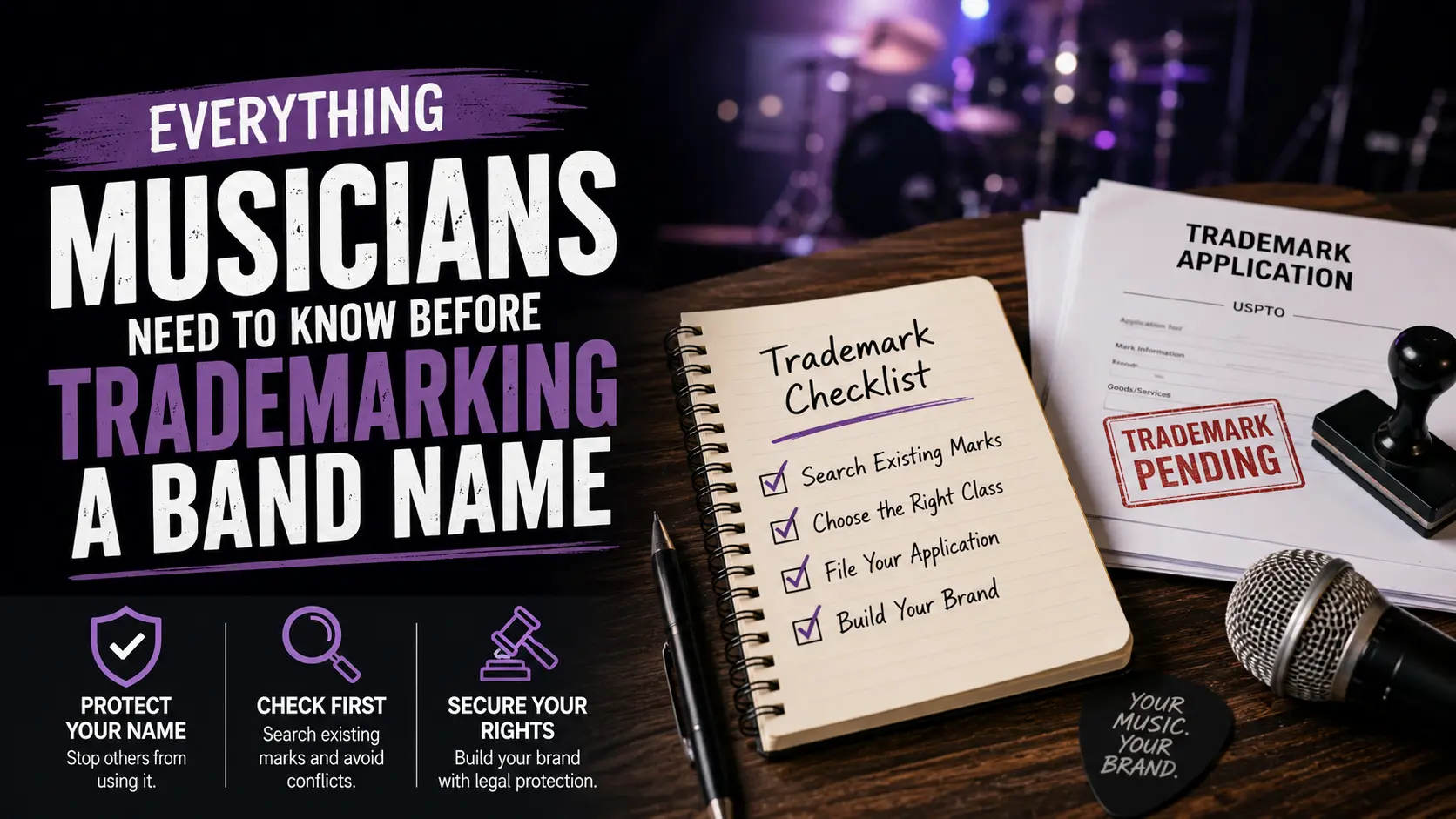
Can trademark band name? Yes. You can protect a band name in the United States either through common-law use in commerce or by filing for federal registration with the USPTO. Federal registration gives you nationwide protection, while common-law rights only cover the geographic area where you've been active.
Most musicians don't think about this until something forces them to. A cease-and-desist email. A distributor flagging a trademark conflict right before an album drops. A Spotify release getting blocked because another artist already registered the name. By then, rebranding costs more than filing ever would have.
This guide walks through the whole process: what trademark actually covers for a band, how to check if your name is free, what the USPTO filing costs in 2026, and where most musicians go wrong.
Why Your Band Name Isn't Automatically Yours
Using a band name in commerce creates something called common-law trademark rights, but they're limited. They protect you only in the geographic area where you've been actively performing or selling, plus a narrow "zone of natural expansion" where a court thinks you might reasonably grow. A band playing shows in Ohio has no legal standing against a band in Oregon using the same name.
Federal registration changes that. Once the USPTO approves your application, you get nationwide rights, a public record other bands can search before picking a similar name, and a stronger legal position if a dispute goes to court.
| Protection Type | Coverage | Cost | Strength |
|---|---|---|---|
| Common-law use | Geographic area where you operate, plus a possible zone of natural expansion | Free (no filing) | Weak, hard to enforce, priority date can be unclear |
| State registration | Within one state only | Varies by state: $10-$100 per class | Limited to that state, no nationwide rights |
| Federal USPTO registration | Nationwide | $350 per class base fee (2026); surcharges of $100-$200 per class may apply for incomplete applications | Strong, enforceable nationwide, legal presumption of ownership |
If you're only playing local shows and have no plans to distribute music, common-law rights might be enough for now. But the moment you upload to Spotify, Apple Music, or start selling merch online, you're operating in a national market. Geography stops being your limiting factor, and so does common-law protection.
The Difference Between Trademark and Copyright for a Band
The difference between trademark and copyright comes down to what each one protects. Trademark protects your band name, logo, and merch branding. Copyright protects your songs, lyrics, and recordings. Two separate legal systems, two different government agencies, and mixing them up is the most common mistake bands make.
Here's the practical version. You can own every note on your debut album and have zero protection for the band name on the cover. Or you can have a federally registered band name and no formal copyright registration for your recordings. Neither one implies the other.
| Element | Trademark | Copyright |
|---|---|---|
| What It Protects | Band name, logo, slogans, merch branding | Songs, lyrics, recordings, album art |
| Granted By | USPTO (federal) or state offices | U.S. Copyright Office |
| Registration Required? | Not required, but strongly recommended | Automatic upon creation, but registration adds legal benefits |
| Duration | 10 years, renewable indefinitely as long as used in commerce | Life of the author plus 70 years |
| Infringement Test | Likelihood of confusion among consumers | Substantial similarity and unauthorized copying |
If another band in a different genre starts using your name, trademark law is what you'd use to stop them. If someone samples your recording without permission, that's a copyright issue. Different problems, different laws.
Here's the part most musicians miss: a band logo can qualify for both. The artwork is protected by copyright, and the brand significance of that logo is protected by trademark. Filing only one leaves a gap a competitor can walk through.
The Free 20-Minute Check Before You File Anything
Before you spend a dollar on filing, check whether the name is already taken. Start with the USPTO's TESS database, then Google the name with "band" or "music," and finally check Spotify, Apple Music, and social platforms for existing acts using the same or similar names.
This isn't optional. It's the cheapest insurance you'll ever buy. A clean Google search doesn't mean a clean trademark search. Plenty of bands skip the USPTO check because it feels like extra work, and it's exactly the step that protects them legally.
- Search USPTO's TESS database for the exact name and close variations.
- Google the name plus "band" or "music" to find active acts.
- Check Spotify, Apple Music, and Bandcamp.
- Search Instagram and TikTok for the handle.
- Note misspellings and soundalikes, since "confusingly similar" names can block your application too.
If you're still deciding on a name, our band name generator can produce dozens of options by genre and vibe. Run any shortlist through the check above before committing.
From Application to Approval: The USPTO Process
To file federally, you pick a trademark class, choose your filing basis (actual use or intent to use), submit the application through the USPTO's online system, and wait through the examination period. As of mid-2026, the USPTO reports first action pendency averaging around 4.5 months and total processing time of roughly 10-14 months for straightforward applications.
For bands, three classes cover almost everything:
- Class 9 covers recordings and downloadable music.
- Class 25 covers merchandise like t-shirts and hats.
- Class 41 covers live performances and entertainment services.
Most bands file under Class 41 first since live performance is the primary use of the name. If you're releasing music and selling merch, you'll likely need to file in all three.
USPTO Filing Fees (2026)
The USPTO overhauled its fee structure on January 18, 2025. The old TEAS Plus and TEAS Standard split is gone. Now there's a single base application fee of $350 per class for electronic filings that meet the base requirements. If your application uses free-form text descriptions or omits required information, surcharges of $100-$200 per class apply. Attorney fees are separate and paid directly to the firm you hire.
| Route | Government Fees (2026) | Best For | Timeline |
|---|---|---|---|
| DIY filing, one class | $350 (may rise to $550 with surcharges) | Simple names, standard descriptions | 10-14 months |
| DIY filing, two classes | $700 base | Live performances plus merch | 10-14 months |
| DIY filing, three classes | $1,050 base | Full band coverage (music, merch, shows) | 10-14 months |
| Intent-to-use filing | $350 per class + $150 per class later for Statement of Use | Bands filing before releasing music | Adds 6-36 months |
| Attorney-assisted filing | $1,000-$2,500+ per class (on top of government fees) | Names close to existing marks | 10-14 months |
One detail most guides skip: you can file on an "intent to use" basis before you've officially launched under the name. This locks in your filing date early, which matters if you suspect another act is circling the same name. You'll need to file a Statement of Use later ($150 per class) once you start using the mark in commerce. Extension requests cost $125 per class, and you can request up to five extensions, giving you up to 36 months after the Notice of Allowance to prove use.
Filing Solo vs. Hiring a Trademark Attorney
About 46% of self-filed trademark applications succeed, compared to roughly 60% of attorney-filed applications. The gap comes down to how well the application handles potential conflicts and office actions from the USPTO examiner.
If your band name is a single made-up word with no existing trademarks in music, filing yourself is reasonable. The USPTO's online system walks you through each step, and the base filing fee is manageable.
If your name is close to an existing mark, uses common words, or could be confused with another act in the same genre, hire an attorney. Attorney fees for a standard trademark application range from $500 to $2,000 per class of goods or services, plus the USPTO filing fee of $350 per class. Large firms can charge $2,000 to $5,000+ per class, though most indie bands don't need that tier.
A simple rule: if you can Google the name and find another band using something similar, get professional help before you file. The extra cost upfront is cheaper than a rejected application, a rebrand after pressing vinyl, or a legal dispute with a bigger act.
Common Mistakes Bands Make With Naming Rights
These come up again and again in trademark disputes and rejected applications.
- Assuming a domain name or Instagram handle equals legal ownership. It doesn't. Those are availability, not protection.
- Picking a name too close to an established act and hoping nobody notices. Distributors and streaming platforms now flag these automatically.
- Waiting until after pressing vinyl or printing merch to check the name. By then, changing course gets expensive fast.
- Filing for one spelling, then performing under another. A trademark is tied to the exact name on the application.
- Assuming "confusingly similar" only applies to identical names. Courts weigh genre, audience, and sound. A slightly different spelling doesn't automatically protect you.
If you're still testing name combinations, our name combiner and word combiner are worth running through before you file, not after. For context on how iconic bands chose their names in the first place, our band name origin stories guide covers the stories behind The Beatles, Pearl Jam, and others.
Frequently Asked Questions
Can I trademark a band name myself, or do I need a lawyer?
You can file yourself through the USPTO's online system. A lawyer helps most when the name is close to an existing trademark, when you're filing in multiple classes, or if the application faces an office action from an examiner.
How much does it cost to trademark a band name?
The USPTO base filing fee is $350 per class in 2026. Most bands file in one to three classes, so the government fee ranges from $350 to $1,050. Surcharges of $100-$200 per class may apply for incomplete applications. Attorney-assisted filing adds $1,000 to $2,500+ per class on top of the government fee.
How long does the trademark process take?
As of mid-2026, the USPTO reports 10-14 months from filing to registration for straightforward applications. Filing on an intent-to-use basis locks in your priority date while you wait, but adds time for the Statement of Use stage.
Does copyright protect my band name?
No. Copyright covers songs, lyrics, and recordings. Band names fall under trademark law, which is handled by the USPTO rather than the U.S. Copyright Office. The difference between trademark and copyright is what each one protects.
What happens if another band already has a similar name?
You may need to change your name, especially if you're in the same genre or market. Trademark law treats "confusingly similar" names as a conflict, not just identical ones. Checking early is much cheaper than rebranding later.
Final Thoughts
Your band name is the first thing people remember and the last thing you want to lose. Filing early, even on an intent-to-use basis, locks in your position and gives you something real to stand on. If the name matters to you, protect it before someone else does.
Updated: September 2026