
What Are Blend Words? 50+ Examples & How to Create Your Own
A blend word (also called a portmanteau) is a new word made by combining parts of two existing words. Brunch takes "br" from breakfast and "unch" from lunch. Smog merges "sm" from smoke and "og" from fog. Unlike compound words, where both words stay whole, blend words drop letters to create something shorter, smoother, and easier to say.
You've probably used a dozen blend words today without even realizing it. Brunch. Smog. Motel. Blog. They're so common that most people never stop to think about where they came from. But once you start noticing them, you'll see blends everywhere: in tech, food, branding, and everyday conversation.
This guide breaks down what blend words actually are, how they're built, where you'll run into them, and how to make one yourself that doesn't sound awkward.

You Already Use Blend Words Every Day
Think about the last time you said "brunch." Or "webinar." Or "motel." These aren't just random words; they're blend words. And you've been using them for years without giving them a second thought.
That's the thing about blends. They slip into your vocabulary so smoothly that you forget they were ever invented. Someone, somewhere, took two words, chopped them up, and fused the pieces together. And now that word lives in your head rent-free.
Brunch. Smog. Blog. Podcast. Spork. Every one of these started as a clever combination of two existing words. And once you learn how they're built, you'll start spotting them everywhere.
Blend Words vs. Compound Words: What's the Real Difference?
The difference comes down to what survives. Compound words join two whole words with nothing removed. Blend words keep only fragments of each original word.
Take "toothbrush." Both "tooth" and "brush" are fully there. You can hear each word clearly. Now take "brunch." Neither "breakfast" nor "lunch" survives in full. You only get "br" and "unch." That's the tell.
| Blend Words | Compound Words |
|---|---|
| Merge parts of words | Join whole words |
| Letters get dropped | Both words stay intact |
| Brunch (breakfast + lunch) | Toothbrush (tooth + brush) |
| Smog (smoke + fog) | Football (foot + ball) |
| Motel (motor + hotel) | Raincoat (rain + coat) |
Here's a simple test: if you can pull the original words back out cleanly, you're looking at a compound. If pieces are missing, it's a blend.
Blend Words vs. Consonant Blends: Two Very Different Things
Confusing, right? I used to mix these up all the time. "Blend word" and "consonant blend" sound similar, but they're totally different.
A consonant blend? That's a phonics thing. It's when two or more consonants sit together and you hear each sound. Like the "bl" in black, or "tr" in tree. Teachers use it when kids are learning to read.
A blend word is different. That's linguistics. You take two whole words and mash parts together to make a new one. Brunch, smog, motel, those are blend words.
| Term | Meaning | Example | Field |
|---|---|---|---|
| Blend Word | Two words merged | Brunch (breakfast + lunch) | Linguistics |
| Consonant Blend | Two consonants together, each sound heard | Bl in black | Phonics |
| Silent E / Magic E | E at the end changes vowel sound | Cap to cape | Phonics |
| 3-Syllable Words | Words with three syllables | Ba-na-na | Phonics |
So if you're a teacher looking for consonant blend activities, that's a different topic. This guide is about blend words, the portmanteau kind.
How Blend Words Are Built (3 Methods)
There's no strict formula, but most blend words follow one of three patterns.
Beginning + Ending Method
This is the most common way. You grab the start of one word and the end of another.
- Breakfast + Lunch → Brunch
- Smoke + Fog → Smog
- Motor + Hotel → Motel
Why does it work? The first part of the first word is what your brain recognizes. The ending of the second word is what makes it easy to say. Simple as that.
Sound-Based Blending
Sometimes you drop letters because it just sounds better. You're not worried about keeping every letter. You're worried about how it rolls off the tongue.
- Electronic + Mail → Email
- Medical + Care → Medicare
See? You don't say "electronicmail." You say "email." That's the whole point.
Syllable Blending
This one follows the syllables. Instead of cutting words in half, you break them where they naturally break when you speak.
- Camera + Recorder → Camcorder
- Internet + Citizen → Netizen
It usually sounds smoother because you're not forcing a weird split. You're just going with the flow.
If you want to experiment with combining words yourself, our Word Combiner tool can generate ideas in seconds.
50+ Blend Word Examples
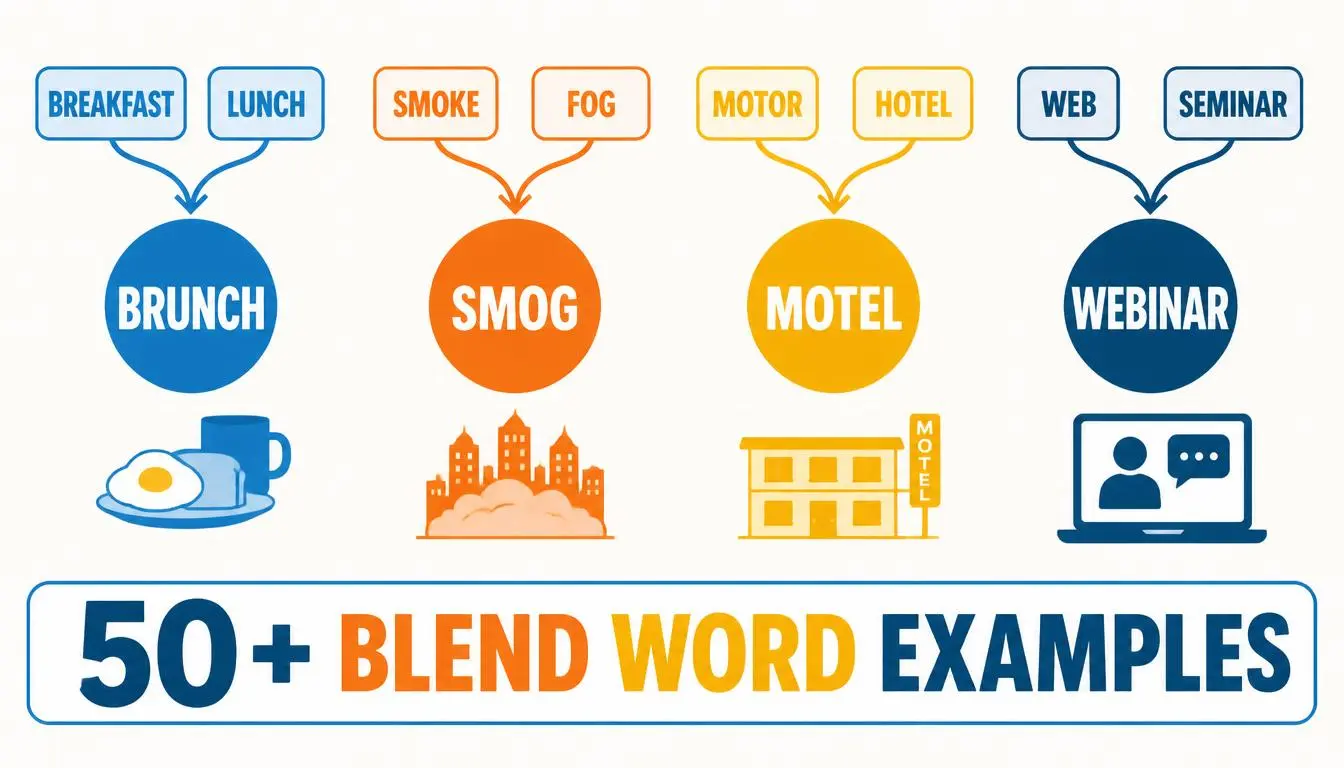
Below you'll find over 50 blend words. I've grouped them so you can scan quickly. Some you probably use every day. Others are brand new, straight from 2025 and 2026.
Everyday Classics
- Brunch – breakfast + lunch
- Smog – smoke + fog
- Motel – motor + hotel
- Email – electronic + mail
- Blog – web + log
- Webinar – web + seminar
- Vlog – video + blog
- Netizen – internet + citizen
Tech & Internet
- Podcast – iPod + broadcast
- Pixel – picture + element
- Malware – malicious + software
- Netiquette – network + etiquette
- Spam – spiced + ham
- Cyborg – cybernetic + organism
- Modem – modulator + demodulator
- Bit – binary + digit
Food & Drink
- Cronut – croissant + donut
- Frappuccino – frappé + cappuccino
- Spork – spoon + fork
- Turducken – turkey + duck + chicken
- Mocktail – mock + cocktail
- Chocoholic – chocolate + alcoholic
- Flexitarian – flexible + vegetarian
- Gastropub – gastronomy + pub
Brands
- Wikipedia – wiki + encyclopedia
- Groupon – group + coupon
- Accenture – accent + future
- Verizon – veritas + horizon
- Netflix – internet + flicks
- Instagram – instant + telegram
- Pinterest – pin + interest
- Microsoft – microcomputer + software
Pop Culture
- Brangelina – Brad + Angelina
- Bennifer – Ben + Jennifer
- Kimye – Kim + Kanye
- Hangry – hungry + angry
- Mansplain – man + explain
- Staycation – stay + vacation
- Glamping – glamorous + camping
- Dramione – Draco + Hermione
Science & Medicine
- Medicare – medical + care
- Breathalyzer – breath + analyzer
- Insulin – insula + -in
- Botox – botulinum + toxin
- Vitamin – vital + amine
- Transistor – transfer + resistor
Modern & Trending (2026)
- Tradwife – traditional + wife
- Broligarchy – bro + oligarchy
- Vibe Coding – vibe + coding
- Delulu – delusional
- Lowkenuinely – low-key + genuinely
- Wasian – white + Asian
- Blouge – blanc + rouge
- Catio – cat + patio
Why Some Blends Stick and Others Fade
Language rewards whatever's easiest to say, remember, and repeat. But that's not the whole story.
Some blends catch on because they fill a real gap. "Brunch" solved a problem: there was no word for that late-morning meal. "Webinar" gave us a way to describe an online seminar without saying "online seminar."
Others stick because they paint a picture. "Smog" instantly tells you what it is, even if you've never heard the word before. Smoke plus fog. The meaning is built right in.
And some fade because they're just too clunky. "Breakfastlunch" never stood a chance. Too long, too awkward. The shorter, smoother version wins almost every time.
Want to go deeper? Merriam-Webster has a great guide on portmanteau vs. blend. It explains the distinction really well.
How Blend Words Shape Brands and Names
Blend words aren't just for linguists. Brands use them all the time.
Why? They're memorable. They're easy to trademark. And they hint at two ideas at once. Accenture (accent + future) sounds precise and forward-thinking. Groupon (group + coupon) tells you exactly what it does. Wikipedia (wiki + encyclopedia) mashes two ideas into one name you can't forget.
Celebrity couple names follow the same logic. Brangelina. Bennifer. Kimye. These aren't just silly portmanteaus; they're brands. They stick in your head because they're short, punchy, and fun to say.
If you're curious about how celebrity blends get built, our couple name maker guide goes deeper into that process.
Where You'll Spot Blend Words Today
Blend words are everywhere once you start noticing them.
Tech: blog, vlog, webinar, netiquette. New concepts constantly need short, functional names.
Food: brunch, cronut, gastropub. Food culture loves a good blend, especially for hybrid dishes.
Social media: hangry, mansplain, delulu, tradwife. These words spread fast because they're relatable and easy to share.
Branding: Wikipedia, Groupon, Netflix. Companies use blends to create distinctive, trademarkable names.
Keep your ears open. You'll start hearing them everywhere.
Frequently Asked Questions
1. I've been using "brunch" my whole life and never knew it was a blend. Is that normal?
Completely normal. Most people use blend words every day without realizing it. Brunch, smog, motel, blog, these words feel so natural that we forget they were ever invented. Someone had to create them. You just inherited them.
2. What's the actual difference between a blend and a portmanteau, or are they the same?
They're the same thing. "Portmanteau" is just the more formal, linguistic term. Both refer to words made by merging parts of two existing words. Use whichever feels right for the context.
3. Is "consonant blend" the same as a "blend word"? I keep getting confused.
Nope, totally different. A consonant blend is a phonics term, like "bl" in black or "tr" in tree. A blend word is a linguistics term, like brunch or smog. Same word "blend," different meanings.
4. Can I just make up a blend word, or does it have to be approved by someone?
You can make up whatever you want. Nobody approves new words. They either catch on or they don't. If people understand it and use it, it sticks. If not, it fades. That's the only rule.
5. Why do some blends like "blog" stick while others disappear?
The ones that stick are usually short, easy to say, and fill a real gap. "Blog" solved a problem, there was no good word for an online journal. "Breakfastlunch" never stood a chance. Too clunky. The smoother, shorter version usually wins.
Final Thoughts
Blend words prove that language keeps solving the same problem: saying more with less. A well-built blend gives you the idea in one word. Brunch instead of "a meal between breakfast and lunch." Webinar instead of "an online seminar."
The best ones are short, easy to say, and still let you hear both original words if you listen closely. Now that you know how they work, try creating a few yourself. If you want to speed things up, our Word Combiner tool can help.
Updated: September 2026