Sq Ft vs Cubic Ft: What's the Actual Difference?
An HVAC contractor sizes a new air conditioner based on cubic feet, not square feet. But homeowners who only know their home's square footage sometimes end up with a unit that's the wrong size for the space. The mix-up isn't rare. These two measurements answer completely different questions, and using one where the other belongs leads to real, costly mistakes.
Understanding sq ft vs cubic ft comes down to one core idea: one measures a flat surface, the other measures the space inside something. Once that distinction is clear, knowing which one applies to a given project gets a lot easier.
The One-Sentence Difference
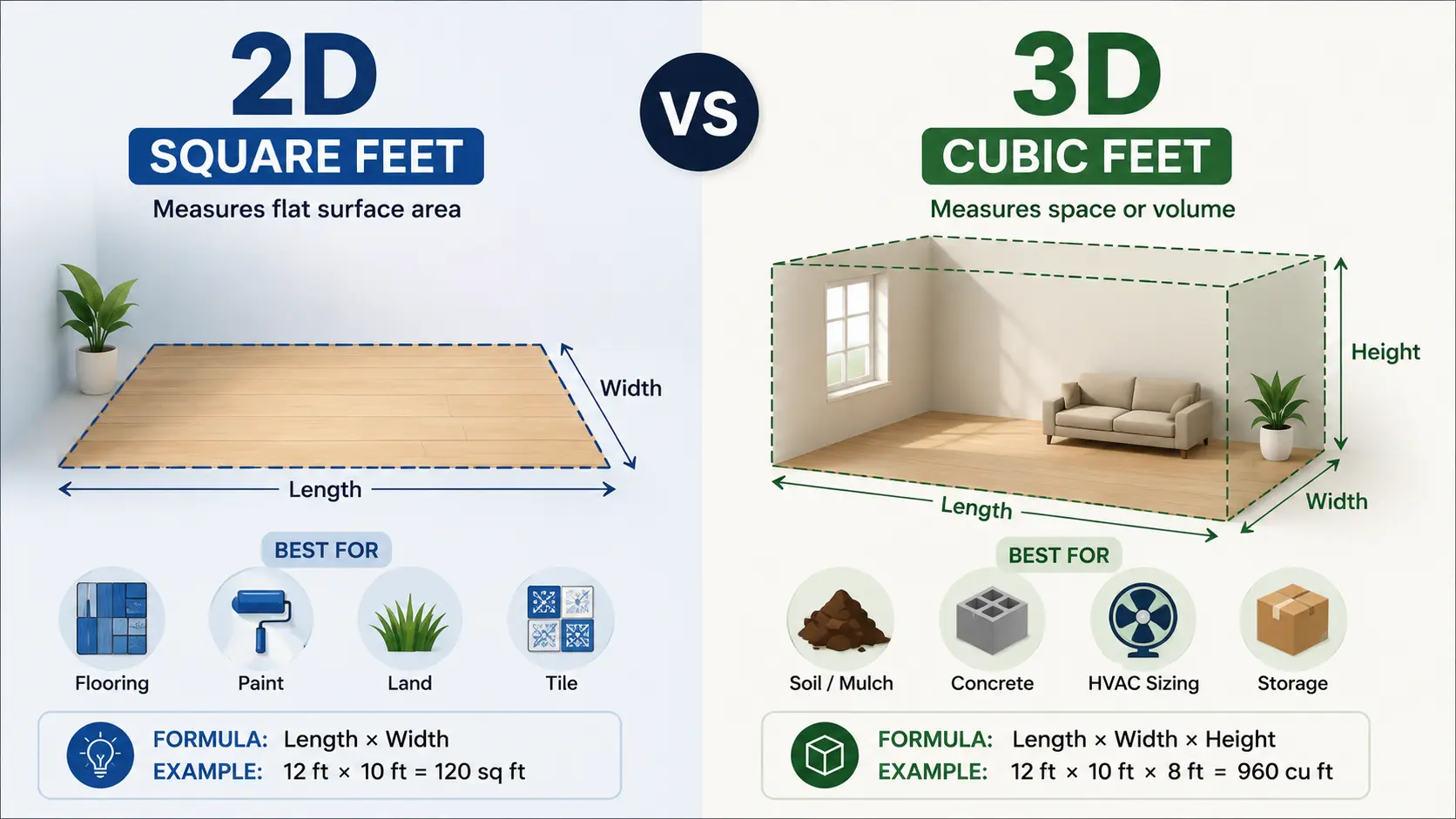
Square feet measures a flat surface. Cubic feet measures the space inside something. That's the whole distinction in one line.
Square footage is two-dimensional — length times width. Cubic footage is three-dimensional — length times width times height. A room's floor is a square footage problem. The air inside that room is a cubic footage problem.
Where Each Measurement Belongs
Most projects fall clearly into one category or the other. Here's the breakdown.
| Measurement | Formula | Common Uses |
|---|---|---|
| Square feet (sq ft) | Length × Width (2D) | Flooring, paint, tile, land area, room size |
| Cubic feet (cubic ft) | Length × Width × Height (3D) | HVAC sizing, concrete, storage volume, water volume |
If the project involves covering a flat surface, you need square footage. If it involves filling a space or measuring air volume, you need cubic footage. The two never swap roles.
HVAC Sizing: Why Ceiling Height Changes Everything
Air conditioners and furnaces are sized based on how much air volume they need to heat or cool. That's a cubic footage question, not a square footage one.
A room with 8-foot ceilings needs roughly 373 square feet of floor space per ton of cooling capacity. A room with 14-foot ceilings needs only 321 square feet per ton, because there's more air volume to condition per square foot of floor. Same floor space, different HVAC requirement. This is why contractors ask for ceiling height, not just room dimensions.
Homeowners who only provide square footage sometimes end up with a unit that's undersized for their space, especially in homes with vaulted ceilings, lofts, or open floor plans that extend vertically.
Concrete Projects: The Most Expensive Mistake
Concrete work makes the square-footage-versus-cubic-footage distinction unavoidable, since a slab or footing always has a specified thickness that has to factor into the order.
A patio slab poured 4 inches thick uses a different volume of concrete than the same square footage poured 6 inches thick. Concrete is typically ordered by the cubic yard, which means converting square footage and thickness into cubic feet first, then dividing by 27.
A 200 square foot patio poured 4 inches deep (0.33 feet) comes to about 66 cubic feet, or roughly 2.5 cubic yards. Ordering concrete based on square footage alone, without specifying thickness, is one of the more expensive versions of this mistake. Concrete trucks typically charge for the full load regardless of whether the order was calculated correctly.
Storage and Moving: Why Square Footage Lies
Moving companies and storage units care about volume, not floor space. A 5x5 storage unit has 25 square feet of floor space, but only 200 cubic feet of usable volume (assuming an 8-foot ceiling). A 10x25 unit has 250 square feet of floor space, but 2,000 cubic feet of volume.
The relationship isn't linear. Doubling the floor space roughly doubles the cubic footage, but the difference between a "small" and "medium" unit is usually described in cubic feet, not square feet, because that's what actually determines how much stuff fits.
How to Convert Sq Ft to Cubic Ft (And Why It Works Both Ways)
There's no direct conversion from square feet to cubic feet, because one dimension is missing. To bridge the gap, you need the height or depth.
The formula: Square footage × Height (in feet) = Cubic footage.
A 300 square foot garden bed filled 6 inches deep (0.5 feet) comes to 150 cubic feet of soil. The square footage told you the area to cover. The depth told you how much material fills that area. Both numbers are required for a correct order.
The same formula works in reverse. If you know the cubic footage and the height, you can calculate the square footage by dividing. But in practice, square footage and height are almost always measured separately, so the multiplication formula is the one you'll use most.
5 Mistakes That Cost Money
- Using square footage for anything that needs to be filled. Concrete, soil, and gravel all require a depth measurement on top of the square footage.
- Assuming HVAC sizing works off square footage alone. Ceiling height changes the actual air volume a unit needs to handle, even when the floor space stays the same.
- Skipping the depth or height measurement entirely. Cubic footage can't be calculated from square footage alone.
- Comparing two spaces by square footage when volume matters. A tall room and a short room with the same floor space hold very different amounts of air, water, or material.
- Ordering concrete or soil without confirming the unit the supplier uses. Some suppliers quote by cubic feet, others by cubic yards. Mixing those up mid-order leads to the same kind of shortfall or overage as skipping the depth measurement entirely.
Frequently Asked Questions
Wait, what's the actual difference between square feet and cubic feet?
Square feet measures a flat, two-dimensional surface. Cubic feet measures three-dimensional volume, adding height or depth into the calculation.
How do I convert square feet to cubic feet if I know the height?
Take the square footage and multiply it by the height in feet. A 200 sq ft room with 8-foot ceilings works out to 1,600 cubic feet of volume.
Why does HVAC sizing use cubic feet instead of square feet?
Because HVAC units heat and cool the air inside a space, not the floor itself. Taller ceilings mean more air volume for a unit to handle, which is why sizing charts go by cubic footage instead of square footage.
Can two rooms have the same square footage but different cubic footage?
Yes. All it takes is a different ceiling height. A 12x10 room with an 8-foot ceiling has 960 cubic feet of volume, while the same 12x10 room with a 12-foot ceiling has 1,440 cubic feet.
Is there a simple way to remember which one to use?
If it holds something (air, water, soil, concrete), use cubic feet. If it covers something (floor, wall, land), use square feet.
Final Rule
If it holds something, use cubic feet. If it covers something, use square feet. That's the entire framework. The conversion between them always needs height or depth, which means you can't skip that third measurement on any project involving fill, volume, or air.
Updated: September 2026