
Can You Copyright a Book Title? What Authors Need to Know
The U.S. Copyright Office has been consistent on this for decades: titles aren't copyrightable. Not obscure ones, not highly original ones, not even titles you invent from scratch. The law excludes them by category, and it doesn't matter how distinctive the words sound to you.
That's the short answer. The longer one involves two separate legal systems, one specific USPTO rule, and a few real cases that show exactly where the line sits. If you've ever typed a book title into a search bar hoping to register it, this is what you actually need to know.
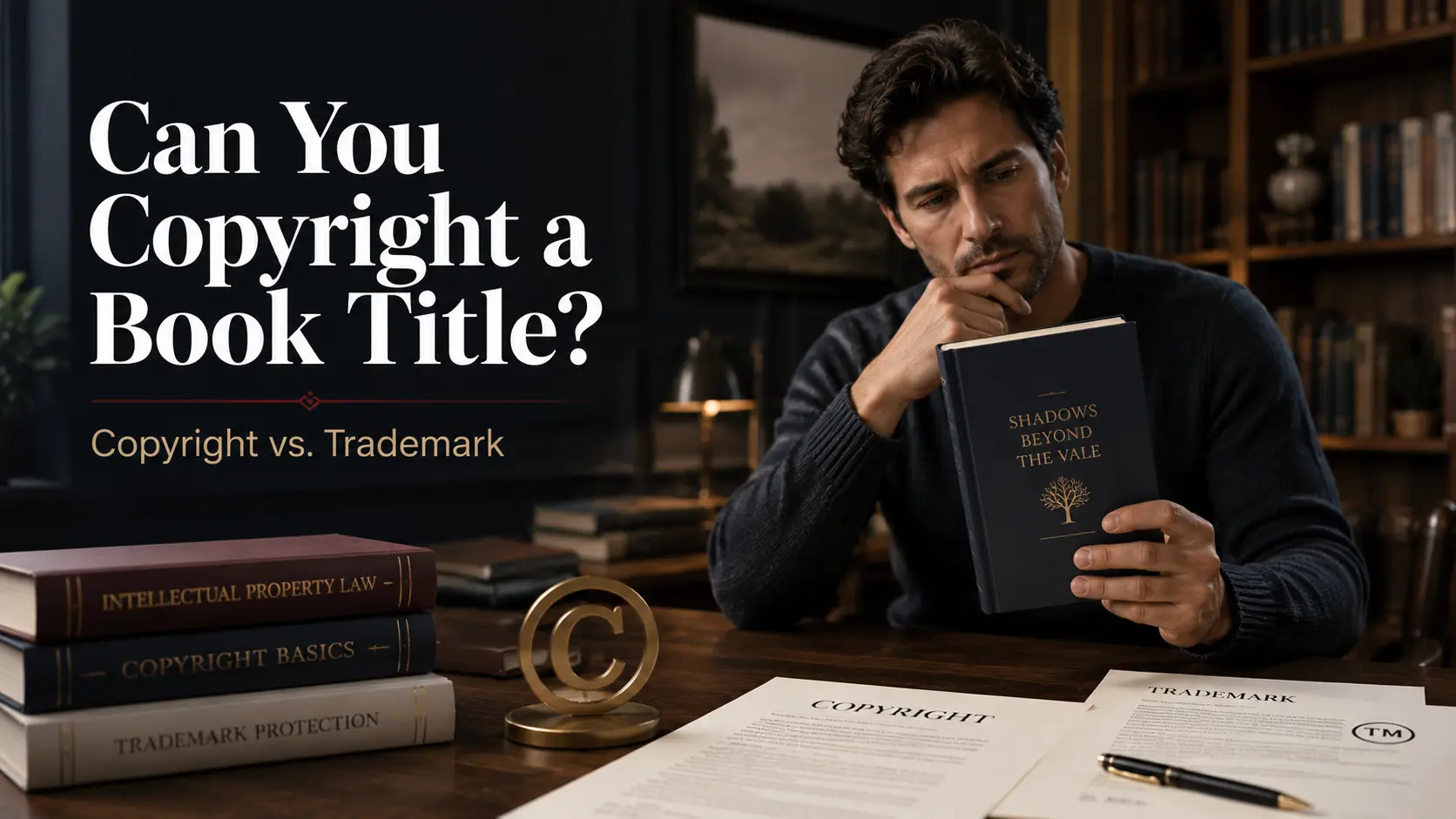
The Short Answer
You cannot copyright a book title. The U.S. Copyright Office's Circular 33 lists "names, titles, and short phrases" under works that are not protected by copyright. The reason is technical but consistent: copyright requires a minimum level of original authorship, and a title is too short to meet that bar.
What you can copyright is the content inside the book. The prose, the structure, the specific expression of your ideas — all of that is protected automatically the moment you write it. The title sits outside that protection. It's a label for the work, not the work itself.
That's why you'll find dozens of books called Breathe, Survive, or The Gift. Nobody owns those words. The title isn't the property. The book is.
So Is a Book Title Protected at All?
Sometimes, just not through copyright. This is where most authors get tangled up, so it helps to separate the two systems clearly.
| Protection Type | Covers a Book Title? | What It Actually Protects |
|---|---|---|
| Copyright | No | The written content inside the book |
| Trademark | Sometimes | A title used as a brand across a series or product line |
Copyright protects creative works. Trademark protects brand identity in the marketplace. A single book title is neither a creative work (too short) nor a brand (too isolated). It sits in the gap between the two systems.
The USPTO's Trademark Manual of Examining Procedure is explicit on this. Section 1202.08 states that "the title of a single creative work must be refused registration" unless the title has been used on a series of creative works. That single sentence is why most standalone novel titles can't be trademarked either.
Can You Trademark a Book Title?
Trademarking a book title works differently. Trademarks protect brand identity — names, logos, and titles that consumers associate with a specific source. The USPTO treats the title of a single creative work as descriptive, not as a brand identifier. A standalone novel, even a bestseller, rarely qualifies.
A series is different. Once a title spans multiple books, or extends into merchandise, courses, or media, it starts functioning like a brand. That's what trademark law is built to protect.
Real Examples of Trademarked Book Titles
Chicken Soup for the Soul is a registered U.S. trademark (Registration No. 2140364, filed in the mid-1990s and still active). It protects the series and its printed-matter brand, not any single volume in the collection. The For Dummies series works the same way (Registration No. 2144335). The name is trademarked as an umbrella brand covering hundreds of individual titles, from cooking to coding.
Neither trademark covers "a book." Both cover a recognizable, ongoing brand built out of many books. That's the pattern worth remembering.
How to Trademark a Book Title
If you have a legitimate case — a series, a branded product line, or a title tied to courses or merchandise — the process involves a few specific steps.
- Confirm the title functions as an ongoing brand, not just a single book's name.
- Search the USPTO's trademark database (TESS/Trademark Search) to check nothing similar already exists.
- Identify the right classification. Printed book series typically fall under International Class 16 (paper and printed matter). A broader brand may need additional classes.
- File a trademark application through the USPTO, based on current use or intent to use.
- Expect the process to take several months and involve a filing fee per class.
Which Trademark Class Do Book Titles Use?
| Class | What It Covers | When to Use It |
|---|---|---|
| Class 16 | Printed books, paper goods, printed matter | Physical books and series branding |
| Class 9 | Downloadable e-books, audiobooks | Digital editions |
| Class 41 | Educational and entertainment services | Courses, teaching, publishing services |
| Class 25 | Apparel | Book-branded merchandise |
In 2026, the USPTO base filing fee is $350 per class. Attorney-assisted filing adds $500 to $2,500+ per class, depending on complexity. Most authors pursuing a series brand file in Class 16 first and expand only if the brand genuinely extends beyond printed books.
How to Copyright a Book Name — And Why It Won't Work
If you've been searching "how to copyright a book name," here's the honest answer: there isn't a form for it. The Copyright Office explicitly excludes titles from copyright protection, along with short phrases, slogans, and lists of ingredients.
You can copyright your manuscript the moment you write it. That protection is automatic. But the title itself sits outside that protection. No application, no fee, no registration will change this.
What you can do instead is protect the book around the title. Register the copyright for your manuscript. Build the content that gives the title meaning. If the title becomes a brand through a series or product line, pursue trademark protection. The title doesn't get protected in isolation. It gets protected as part of something larger.
What About Outside the US?
The core principle holds in most countries with similar intellectual property systems. The UK, Canada, Australia, and India all exclude standalone titles from copyright protection for the same reason: titles are too short to meet the originality bar.
| Country | Copyright Titles? | Governing Body |
|---|---|---|
| United States | No | U.S. Copyright Office |
| United Kingdom | No | UK Intellectual Property Office |
| Canada | No | Canadian Intellectual Property Office |
| Australia | No | IP Australia |
| India | No | IP India |
Trademark rules follow a similar series-vs-single-book logic internationally too, though the specific application process and governing body differ by country. If you're publishing outside the US, it's worth a quick check with your country's trademark office rather than assuming the US rules apply directly.
Should You Still Check If Your Title Is Available?
Yes, but not for legal reasons. Even without formal protection, a title that's identical to a recent bestseller can hurt you in practical ways. Readers get confused, your book gets buried in search results, and reviews meant for the other book sometimes land on yours by mistake.
Consider what happened when Paula Hawkins published The Girl on the Train in 2015. An earlier novel called Girl on a Train saw an unexpected sales bump from readers confusing the two titles. That's not a legal problem. It's a discoverability problem, and it's the one most authors actually face.
A quick search on Amazon, Goodreads, and Google before you commit costs five minutes. If your exact title is already an active trademark — usually a franchise, brand, or series — reconsider it. If it's just a single unrelated book from years ago, you're almost always fine.
If you're still deciding on a title, our book title generator can produce ideas by genre, mood, and keyword, giving you a shortlist to check before you commit.
Common Situations Authors Ask About
My Title Matches an Old, Obscure Book
Generally fine. Copyright doesn't cover titles, and trademark issues only arise with active, brand-level use. An obscure book from decades ago rarely has any of that.
My Title Matches a Current Bestseller
Legally you're probably still fine. Practically, reconsider. You'll be competing for search visibility and shelf space with a book that already owns that phrase in readers' minds. If your genre overlaps at all, that's a fight worth avoiding.
I Want to Register My Title to Lock It In
There's no registry for that. The closest thing is registering an ISBN, which identifies your specific edition but doesn't grant you rights over the title itself. Copyright registration covers the manuscript's content, not the title. Trademark registration covers the title only if it functions as a brand across a series or product line.
I'm Planning a Series, Not Just One Book
This is the scenario where trademark actually makes sense. Once you've locked in your series name and have a title for book one, decide early whether the series name is worth protecting as a brand. If the answer is yes, the filing process outlined above applies. If the answer is no, you're back to the same position as any standalone author: no legal protection for the title, but full copyright on everything inside the book.
Frequently Asked Questions
Why can't I copyright a book title in the US?
Because the Copyright Office requires a minimum level of original authorship, and a title is too short to meet that bar. Circular 33 lists "names, titles, and short phrases" as explicitly outside copyright protection. This isn't a technicality that better titles can get around. It applies to every title, regardless of how original it sounds.
What if my book title is completely original — can I copyright it then?
No. Originality doesn't change the rule. Titles are categorically excluded from copyright protection. Even a made-up word that has never been used before won't qualify, because the exclusion is about length and function, not novelty.
Can I trademark my book title instead?
If your title acts as a brand across a series, merch line, or course, you can trademark it. Class 16 covers printed books. Other classes apply if the brand goes beyond that.
Can two books share a title?
Yes. Titles aren't copyrighted, so it's legal and common for unrelated books to have the same one.
What should I do if my title matches another book?
Check how recent and how prominent the other book is. If it's an obscure book from years ago, publish as planned. If it's a current bestseller in your genre, consider whether a different title would serve you better. Searching the USPTO's TESS database is also worth doing, in case the title is part of a registered series brand.
Final Summary
The law is clear. A book title can't be copyrighted. What you can protect is the content inside the book, and in some cases the title as a brand if it belongs to a series. That's the entire framework. Everything else is deciding what to do with a title that the law lets everyone share.
Updated: September 2026